
NEWS
The IDF Turns Drones Into a Fourth Fighting Arm
Zamir will stand up a fourth IDF service for unmanned systems and AI by Hanukkah, promoting robots that already fought.

IDF Chief of Staff Lt. Gen. Eyal Zamir said on September 8 that the military will open a fourth branch for unmanned systems and AI by Hanukkah. He spoke at the 153rd Naval Officers Course at Haifa Naval Base and left the army, air force and navy without a commander, a budget or a list of units that will move.
The Israel Defense Forces have three fighting arms now, the Ground Forces, the Air Force and the Navy, each led by a major general. Adding a fourth is a first. Zamir, chief of staff since March 2025 after a stint as director general of the Ministry of Defense, said in the week before the speech he had finalized plans for the Unmanned Systems and Artificial Intelligence Branch and called the step a once-in-a-generation transformation.
The IDF Will Now Have Four Fighting Arms
Zamir told the new naval officers the battlefield is changing at a dizzying pace, and that the IDF is changing with it. “We understand that the future includes unmanned systems, robotics, drones and widespread use of artificial intelligence,” he said. Maritime, land and aerial robotic tools will be built, he added, so they can work with manned combat teams or run missions on their own.
“They will increase operational activity on the battlefield and save human lives,” he said. He wants the IDF to be a global leader in the field, and he tied the standup to Hanukkah in early December. Hanukkah begins at sundown on December 4 and runs through nightfall on December 12.
He did not say whether the new branch will be led by a major general, as the other three are. He did not say how it will sit beside the C4I and Cyber Defense Directorate, which already runs the military’s AI systems and last year stood up an Information and Artificial Intelligence Division. The announcement promotes a set of tools to the same legal rank as the army, the air force and the navy, and stops there.
THE IDF’S ARMS AND THE NEW ONE
| Body | Status | Unmanned work now | Leader |
|---|---|---|---|
| Ground Forces | Branch | Drones, remote bulldozers, explosive M113 carriers | Major general |
| Air Force | Branch | UAVs and drones, with artillery also flying UAVs | Major general |
| Navy | Branch | Drone boats; autonomous tools above and below the sea still to come | Major general |
| C4I and Cyber Defense | Directorate | AI systems, Information and AI Division | Major general (staff, not a fighting arm) |
| Unmanned Systems and AI | Branch planned | Land, air and sea robotics, manned teams or solo missions | Not named |
Yaakov Katz, author of The Weapon Wizards and a fellow at the Jewish People Policy Institute, said the decision reflects a growing understanding inside the IDF that robotics, autonomous vehicles and AI-powered systems are changing modern warfare and can even decide a battle. As swarms and other autonomous munitions spread, he said, the ability to process huge amounts of data at speed is becoming critical, and the same tools can add combat power while saving lives in ways that were not possible before.
Tens of Thousands of Robots Already Fought This War
The branch is arriving after the tools have already been in the fight. In December 2025, Yaron Sarig, head of the Defense Ministry’s AI and Autonomy program office, called the war the first robotics war and said Israel had fielded tens of thousands of autonomous systems across the battlefield, from drone swarms to ground robots spread over wide areas. He said robotics is a bridge into AI that will sit inside every weapon and every soldier’s kit, and that the ministry expected the robotic force to grow.
This is the first robotics war. In this conflict, we have mobilized our entire defense ecosystem and deployed tens of thousands of autonomous systems across the battlefield, from drone swarms to agile ground robotics distributed across vast areas.
Yaron Sarig, Head of AI and Autonomy PEO, Israel Ministry of Defense, December 2025
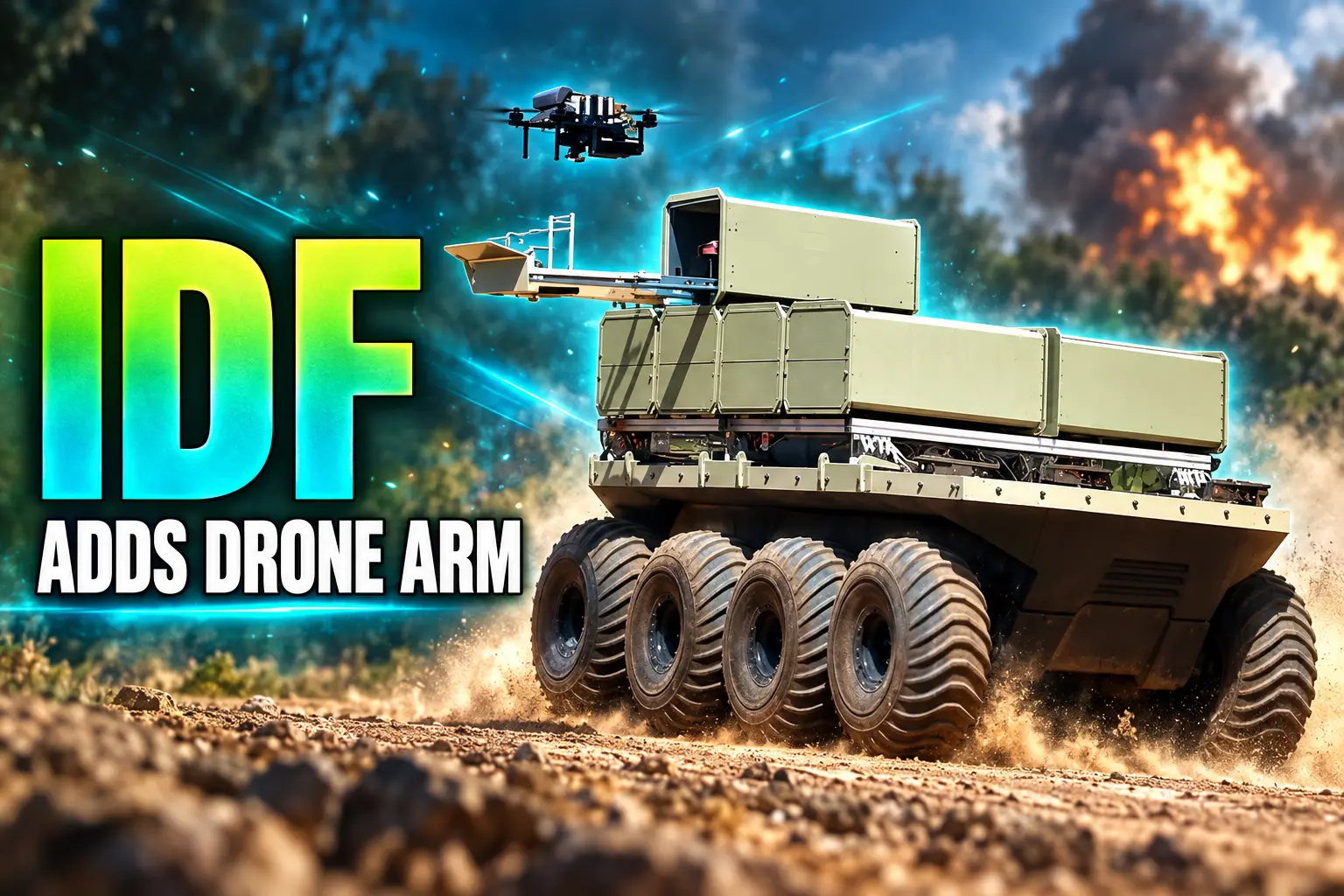
Those systems did not wait for a new service. The Air Force and the Ground Forces’ Artillery Corps already fly UAVs and drones. The Navy has put drone boats in the water. Ground units send in remotely controlled bulldozers and retired M113 armored personnel carriers packed with explosives; one of those remote M113s was detonated in Rafah on April 21, 2025. The new branch’s job, on paper, is to own a field the three arms have been improvising under fire.
Why a Directorate Was No Longer Enough
Israel has spent two years stacking AI offices under staff hats. The Ministry of Defense opened an AI and Autonomy Administration in January 2025 under the Directorate of Defense Research and Development, the first extra ministry directorate in more than two decades, to lead research, development and force building with the army, universities, defense firms and startups. Zamir was still the ministry’s director general when that push took shape, after he had spent the months after October 7, 2023, keeping Israel supplied and placing long-term orders.
Inside the IDF, the C4I and Cyber Defense Directorate took the AI portfolio and last year added the Information and Artificial Intelligence Division. That is a staff fix for a staff problem: how to fuse sensors, write targeting aids and keep networks up. A branch is a different animal. It is a service that can hold people, kit, doctrine and a claim on the budget in the same way the navy does.
Former Chief of Staff Aviv Kohavi, whose term ended in January 2023, had already bet on digitization. During his watch the IDF rolled out the naval C-Dome air defense system, the Sa’ar 6-class corvette and the Skylark 3 UAV, and it wrote a Momentum plan meant to turn those advances into a more lethal force. After October 7, that high-tech focus was attacked, because ground units looked unready for a mass raid by lightly armed militants. The new branch does not walk that bet back. It writes unmanned systems into the force chart instead of leaving them as add-ons to Momentum-era units.
HOW AI MOVED UP THE ORG CHART
- January 2023: Kohavi leaves office after a digitization drive that included C-Dome, Sa’ar 6 ships and the Skylark 3 UAV.
- October 7, 2023: Hamas’s raid exposes gaps in ground readiness and in how the army read a flood of sensors and warnings.
- January 2025: The Defense Ministry opens the AI and Autonomy Administration under its research directorate.
- March 2025: Zamir becomes chief of staff after running the ministry’s procurement shop through the war.
- Late 2025: C4I stands up an Information and Artificial Intelligence Division; Sarig describes tens of thousands of robots already in the fight.
- September 8, 2026: Zamir announces a fourth branch and sets Hanukkah for the standup.
At the same Haifa ceremony he talked about the Hoshen multi-year plan, which is supposed to start in the coming years, and he put extra weight on the maritime arena. He noted the navy had recently taken delivery of INS Drakon, the latest Israeli submarine from Germany, and he promised the navy would also get advanced autonomous systems above and below the sea. The speech put ships, submarines and robots on one stage, then asked a new branch to own the robots.
Elbit Lined Up a Swarm Shop the Next Day
On September 9, Elbit Systems, Israel’s largest defense firm, unveiled FUSE, a unit inside its C4I and Cyber business that packages AI-driven autonomous combat systems. The center of the pitch is Dominion-X, an AI operating system Elbit says can run One2Many control of aerial and ground formations in GNSS-denied environments, with automatic target recognition and homing, and with platforms sharing mission data on a common network. FUSE said its kit has logged more than 1,000,000 operational flight hours and over 100,000 autonomous ground hours, with thousands of drones and hundreds of unmanned ground platforms already delivered.
The company said those systems are already in service with customers in Israel, the United States and Europe. For the quarter ended June 30, 2026, Elbit reported $2,287.1 million in revenue and a $32.0 billion order backlog, and it employs over 21,000 people. FUSE is not a lab demo looking for a first buyer. It is a factory line looking for a service that can write doctrine for swarms.
WHAT FUSE PUT ON THE TABLE
- One2Many control: Dominion-X is built so a small set of operators can coordinate large aerial and ground groups in real time, including when satellite navigation is jammed.
- Urban lethality: Mass unmanned ground vehicles and one-way attack drones are aimed at indoor and fortified targets so people do not have to go in first.
- Armored wingmen: Unmanned ground and air assets are meant to work beside manned armor or launch from it.
- Border watch: Mobile, deployed and fixed unmanned ground and air assets are sold as autonomous border protection with little staffing across wide areas.
- Ground kits: Hardware and software kits are designed to turn existing off-road vehicles into autonomous or teleoperated machines.
Military forces are entering a new operational era in which combat effectiveness will increasingly depend not only on autonomous platforms themselves, but on the ability to integrate and coordinate large numbers of autonomous systems within existing maneuver forces in real time.
Eyal Dahan, CEO of FUSE, Elbit Systems statement, September 9, 2026
At a private briefing the same day, Dahan said even mass swarms would not fully replace soldiers, while other Elbit officials said fewer people may be needed on defense to run the vehicles. Officials also said a human would still sign off on targeting, a limit that matters once Zamir’s own language about independent missions is taken at face value. The same week, the Ministry of Finance said Israel ranked 3rd in the world in AI commercialization, 6th in development and 7th in research, out of 83 countries, and that high-tech capital raised rose 53.6% in the first half of 2026 from the first half of 2025. The military is standing up a buyer. The industry and the fundraising tables were already in that trade.
Ground, Air and Navy Still Fly the Hardware
Nothing in the Haifa speech strips the air force of its UAVs or the navy of its drone boats. The Ground Forces still send the remote bulldozers and the explosive carriers. Zamir said the new branch will be responsible for a rapidly developing field and that robotic capabilities will be developed on land, in the air and at sea. He did not read out a transfer list.
That gap is the live fight inside the General Staff. A fourth branch with no assigned squadrons is a title. A fourth branch that pulls the Air Force’s UAV squadrons, the artillery’s drones and the navy’s unmanned boats would be a raid on three other major generals. C4I’s new Information and AI Division sits in the middle of the same argument, because algorithms and airframes are being asked to live in one service while the people who fly and maintain the airframes still belong to someone else.
The navy had the microphone, so Zamir promised it fruit: autonomous systems above and below the surface, on top of Drakon and the Hoshen plan’s maritime focus. Submarines and robot boats can share a speech. They do not automatically share a chain of command. Until the standup orders name which flotillas, UAV squadrons and ground-robot companies report where, the three arms keep the hardware and the new branch keeps a claim.
Who Commands a Machine That Fights Alone?
Zamir’s most load-bearing line is not the Hanukkah date. It is the claim that unmanned systems will fight beside manned teams or carry out independent missions. Beside is familiar: a soldier with a quadcopter, a tank with a wingman drone, a ship with a drone boat. Independent is a different legal and command problem. If a swarm is sent to take a block of houses with no infantry in the street, the officer who wrote the order still needs a name, a rank and a rule for abort.
Elbit’s briefing, a day later, still put a person on targeting sign-off. That is the contractor’s comfort language. It is not yet the IDF’s published targeting directive for a branch that does not exist. The loudest objection to the announcement is not that Israel flies too many drones. It is who stands in the dock, or in the debrief, when a machine on a solo task hits the wrong house or fails to fire. Promoting robots to a service does not, by itself, write that rule.
WHAT WE KNOW
- The date: Zamir set the standup for Hanukkah in early December, and Hanukkah begins at sundown on December 4.
- The rank of the idea: The IDF has three fighting branches today; a fourth would match them, not C4I’s staff directorate.
- The fight already run: Sarig said in December 2025 that tens of thousands of autonomous systems had already been deployed.
- The industrial pair: Elbit unveiled FUSE on September 9 as a swarm and robot shop with hours already on the clock.
WHAT IS UNCONFIRMED
- The commander: No major general or other officer has been named to lead the branch.
- The transfer list: No UAV squadron, drone-boat flotilla or ground-robot company has been ordered to move.
- The C4I split: It is not public whether the Information and AI Division folds into the new branch or stays a staff shop.
- Solo-mission rules: There is no published directive on who authorizes, aborts and answers for an independent unmanned strike.
Specialists who watch military robotics read the news as an org-chart event, a roof over work the services already do, because Zamir offered no size, no rank table and no map of who reports to whom. That reading is fair. A branch that exists only as a Hanukkah ceremony is still a signal to industry and to the other arms. It is not yet a force.
Zamir Booked Hanukkah and Left the Rank Empty
Between September 8 and sundown on December 4 the General Staff has to turn a graduation-line promise into an order of battle. Someone has to be named to command it. Someone has to decide whether C4I keeps the models and the new branch keeps the airframes, or whether those sit in one house. Someone has to write the rule for a mission with no manned team on the ground.
Zamir spent the war years as the ministry’s supply chief, then took the army with a mandate to rebuild after October 7. He is now telling that army that unmanned systems, robotics, drones and AI are the future and that they will save human lives. The robots are already in the inventory. The missing piece on December 4 is not another prototype. It is a commander and a chain of command that can live with a machine sent out alone.

Jay-Z Accuser Recants, but Her Lawyer Remains Sued

Treasury Squeeze Forces Iran’s Neighbors to Cut Banks and Flights

iPhone 18 Pro Preorder Deals Wipe $1,199 Over 36 Months

U.S. Steel and Aluminum Duties Hit the Factories That Use Them

A Yemen Cell Used Claude Code, Then Kept the Toolkit

Sharon AI Walks an $8.8 Billion Book Into Goldman

CDC Holds Pennsylvania Measles Deaths Off the U.S. Tally

Copper’s Longest Rally Since 1994 Sits in U.S. Warehouses

Tropical Storm Edouard Left Houston Open and Beaumont Dark

The Agent Harness Turns Safety Into Switching Cost
-
 NEWS3 weeks ago
Sharon AI Walks an $8.8 Billion Book Into Goldman
-
 NEWS4 weeks ago
CDC Holds Pennsylvania Measles Deaths Off the U.S. Tally
-
 BUSINESS3 weeks ago
Copper’s Longest Rally Since 1994 Sits in U.S. Warehouses
-
 NEWS1 month ago
Tropical Storm Edouard Left Houston Open and Beaumont Dark
-
 NEWS3 weeks ago
The Agent Harness Turns Safety Into Switching Cost
-

 BUSINESS4 weeks ago
Cash Still Buys Nearly One in Three U.S. Homes
-

 LIFESTYLE1 month ago
Congo Rolls Out Ervebo Against a Different Ebola Virus
-

 NEWS3 weeks ago
Nationwide Bets on Data Work Before It Trusts Agents