
NEWS
The Kids Act Turns a Child Ban Into Age Checks
Von der Leyen’s Kids Act would bar under-13s from social media and force age checks on new accounts, after Australia’s harder ban still leaked.

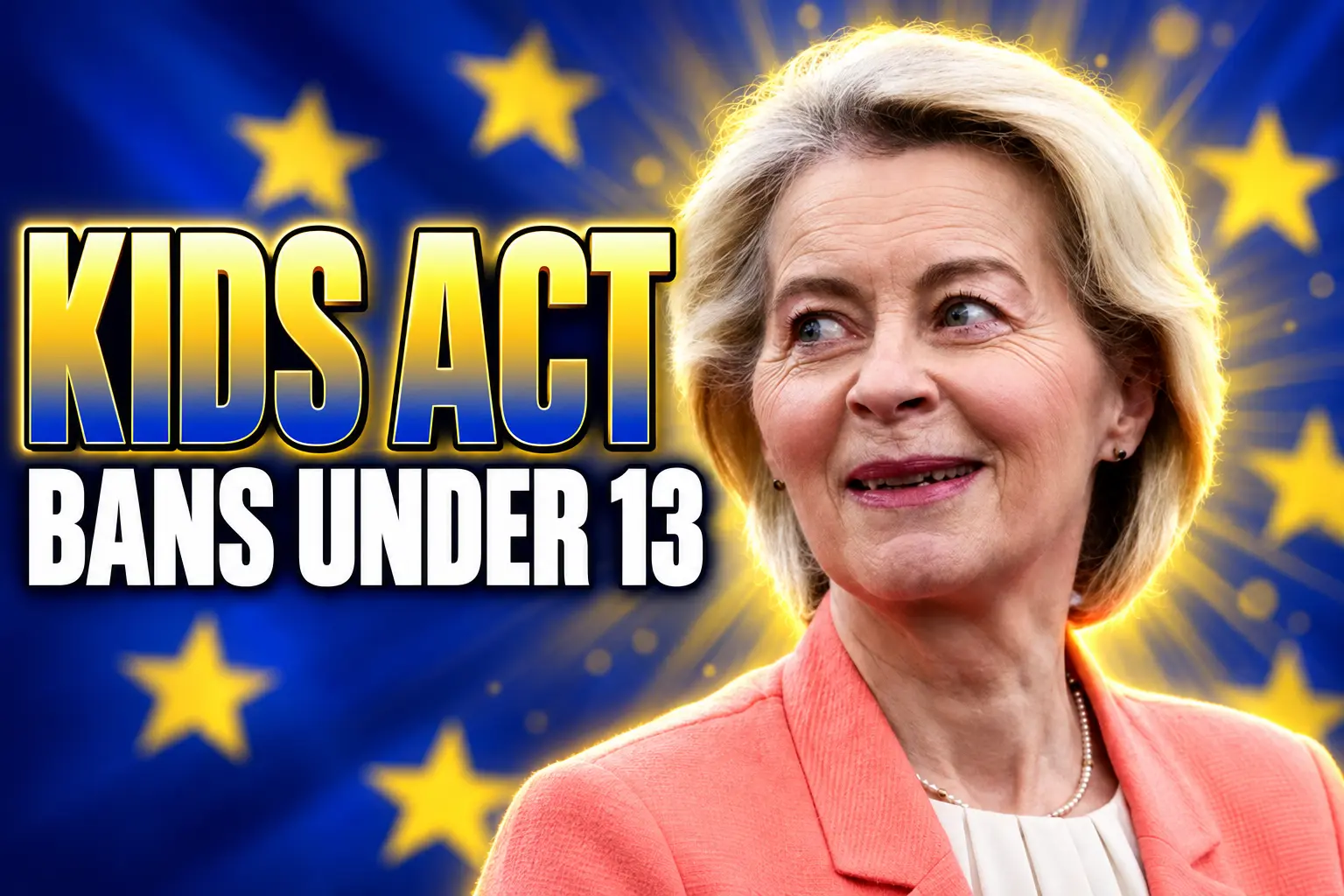
Ursula von der Leyen told the European Parliament in Strasbourg on September 16, 2026, that the Commission will propose an EU Kids Act that bars children under 13 from social media. From 13 until a child turns 15, she said, only mini accounts set up and supervised by parents would be allowed, with limited features and a cap of one hour a day.
The public fight is about children. The operating system is an age check at sign-up, and that gate does not open for a 12-year-old unless it also closes on everyone else.
No Social Media Under 13, Mini Accounts Until 15
The floor and the one-hour cap were the lines she chose for the 2026 State of the Union address. Between 15 and 18, she said, safe design would be an obligation for the platforms, and the burden of proof would flip: companies would have to show their services are safe, rather than wait for a regulator to prove they are not. The legal text itself is due on September 17, 2026, presented with Executive Vice-President Henna Virkkunen, and it still has to clear the 27 member states and the European Parliament before it binds anyone.
She described a gradual ladder, not a single switch. “Each age has its own sensitivities. And therefore, each will have its own tailored protection level,” she told lawmakers. In the same passage she ruled out personal accounts before 15, which leaves 13- and 14-year-olds on the same apps under a parent’s login, a short daily timer, and a thinner feature set.
THE AGE LADDER SHE ANNOUNCED
| Age | What she said they may use |
|---|---|
| Under 13 | No social media |
| 13 until 15 | Mini accounts set up and supervised by parents, limited features, one hour a day |
| 15 to 18 | Own accounts, with safe design an obligation for platforms |
Draft papers circulating ahead of the vote describe a slightly softer lower rung than the speech. They would still bar access under 3, then let parents open fully controlled accounts on child-friendly services for ages 3 to 12, and they use “introductory accounts” for the 13-to-15 band. Until the adopted text is published, the public rule is the one she read out: no social media under 13, no personal account under 15.
She also put a time figure on the problem the law is meant to cut. Young people, she said, now spend four to six hours a day on screens, pulled into feeds built to keep them scrolling, including photos of girls turned into AI-generated sexualised images.
The Kids Act Only Works If Everyone Shows Their Age
A platform cannot keep a 12-year-old off Instagram unless it can tell a 12-year-old from a 20-year-old. Self-declared birthdays already fail that test, which is why the draft would oblige social media and video-sharing services to run age checks whenever a user opens a new account, using the EU’s own tool or a national equivalent that meets the same bar for accuracy, privacy and non-discrimination. Existing accounts would get a lighter pass, with examples such as a long-lived login or a credit card in the holder’s name.
That is a shift, not a tweak. The Digital Services Act, in full since February 2024, already tells platforms accessible to minors to keep them safe, and Commission privacy-preserving age checks by December 2026 were framed as a common method member states should offer. The Kids Act would turn a recommended tool into a condition of opening an account on the services in scope. Adults who want a new login walk through the same door, because the software cannot see a child until it has sorted the whole queue.
Because it is not about our minors accessing social media. It is about when and how do we allow social media to access minors.
Ursula von der Leyen, President of the European Commission, 2026 State of the Union address
Agustín Reyna, director of the European consumer group BEUC, warned this week that children need better protection online, but that age checks are not a silver bullet and would raise privacy and data-protection problems of their own. The louder design issue is simpler than the slogan. Once every new account needs a token that says the holder is old enough, the Kids Act is no longer only a rule about children. It is a checkpoint on the open web, paid for in IDs, face scans or bank cards, and it will be judged on whether 13-year-olds still slip through with a borrowed phone.
A Special Panel and a Belgian Girl Named Oléa
The speech reached for a name before it reached for a clause. Von der Leyen told the chamber about Oléa, a 14-year-old girl living in Belgium who took her life a month before the address, a victim of online bullying. She quoted the French line “C’est trop,” then said enough is enough. She had already commissioned experts, spoken to young people, and, in her own words, looked at Australia and others who had moved ahead.
That expert track started after her 2025 State of the Union speech. In March 2026 she appointed Prof. Dr. Jörg M. Fegert, director of child and adolescent psychiatry at Ulm University Medical Centre, and Dr. Maria Melchior, an epidemiologist at France’s National Institute of Health and Medical Research, as co-chairs. They met three times through June and handed over a special panel report on child safety on July 13, 2026. The co-chairs argued that providers, not parents or children, should carry the burden of showing that a service is safe by design, and that until they do, access for children under 13 should be restricted across the Union.
HOW THE BAN GOT TO STRASBOURG
- February 2024: The Digital Services Act applies in full, including a duty to protect minors, with no EU-wide minimum age for social media.
- July 14, 2025: The Commission publishes minors-protection guidelines under that Act and a prototype age-check app, still a method rather than a login rule.
- December 10, 2025: Australia’s under-16 account rule takes effect, the example von der Leyen said she was watching.
- March 2026: The special panel begins meeting; Fegert and Melchior are asked for a European approach, including a possible common age limit.
- July 13, 2026: The panel report lands, backing an under-13 restriction until platforms prove they are safe.
- August 14, 2026: France’s Constitutional Council strikes down a national under-15 ban on expression and privacy grounds.
- September 16, 2026: Von der Leyen announces the Kids Act ladder in Strasbourg, with the proposal due the next day.
Member states had not waited for Brussels. Greece has already set national curbs for under-15s to take effect on January 1, 2027. France tried to move earlier and ran into its own court. The Kids Act is the Commission’s bid to replace that patchwork with one ladder, and to write the panel’s reversed burden of proof into law rather than guidance.
Australia Closed 4.7 Million Accounts and Teens Still Logged In
Von der Leyen cited Australia as the pioneer. The Australian rule, in force since December 10, 2025, is harder on paper than the ladder she described: age-restricted platforms must take reasonable steps to stop under-16s holding accounts, with no mini-account middle band. eSafety’s public list has included Facebook, Instagram, Snapchat, Threads, TikTok, Twitch, X, YouTube, Kick and Reddit. Online games and standalone messaging were carved out, a contrast with the EU draft, which would pull games back in.
The first compliance dump looked like a purge. Platforms had taken down or locked 4.7 million age-restricted accounts removed by mid-December 2025, then more than 300,000 extra by the start of March 2026. A parent survey in eSafety’s March update found the share of children with their own account falling from 49.7% to 31.3%. Among parents whose child had an account before the rule, about 7 in 10 said the child still had one. The most common reason, at 66.8%, was that the platform had not yet asked the child to verify an age. eSafety opened investigations into Facebook, Instagram, Snapchat, TikTok and YouTube. Civil penalties can reach 150,000 penalty units, currently A$54.6 million for a corporation.
NINE MONTHS OF AUSTRALIA’S UNDER-16 RULE
| Measure | Figure |
|---|---|
| Accounts removed or restricted by mid-December 2025 | 4.7 million |
| Additional accounts blocked by the start of March 2026 | more than 300,000 |
| Parents saying their child had an own account, before the rule | 49.7% |
| Same measure three months later | 31.3% |
| Prior account-holders whose child still had an account | about 7 in 10 |
| Those parents saying the platform had not asked for an age check | 66.8% |
| Under-16s still using restricted platforms, BMJ follow-up | more than 85% |
Use did not fall with account counts. An observational follow-up found more than 85 percent still using platforms covered by the Act, mostly through their own accounts, after the researchers looked for an immediate drop in harm. Two thirds of those users said they had hit some form of age check, often a typed birthday or a selfie. Fake accounts and private browsers did the rest. The Kids Act copies the architecture (platform duty, age assurance, fines) and then adds a two-year supervised band Australia never tried. If the Australian leak came from weak checks, Brussels is betting a mandatory EU tool will hold. If the leak came from borrowed phones and new emails, a one-hour mini account is just another login to spoof.
Why a National Ban Collapsed in Paris
France’s Constitutional Council on August 14, 2026, struck down Article 1 of a law that would have barred under-15s from social media from September. Lawmakers had passed the bill in July, and President Emmanuel Macron had wanted it in place for the new school year. The Council held that the contested provisions disproportionately infringe upon the freedom of expression and communication, and that they fail to provide the legal safeguards necessary to ensure the right to respect for private life.
The privacy limb is the one that maps onto the Kids Act. The French text implied that every person, including an adult, would have to prove an age before opening or keeping an account, and the Council said the law did not set the conditions and limits for that proof. Macron asked Prime Minister Sébastien Lecornu for a legally robust rewrite, with the Élysée still aiming for spring 2027 and telling the government to weigh the European legal frame as well as the ruling.
An EU regulation is not a French statute, and Charter arguments in Luxembourg are not a Paris communiqué. The collision is still the same two rights the Council named. A floor of 13 with parent-run mini accounts until 15 is narrower than France’s attempted under-15 cutoff, which is why von der Leyen can sell it as tailored. The age-check machinery is not narrower. If every new TikTok login in the Union needs a token, the Kids Act walks back into the problem Paris already labelled: a child rule that inspects adults, written without the safeguards a court wanted to see on the page.
The Draft Also Sweeps In Games and Chatbots
The speech stayed on social media. The draft Communication circulating before September 17, 2026, does not. It defines a “Social Media+” bucket that covers social media, video-sharing platforms and online games that pose design risks for minors, plus AI chatbots and companions described as tools that can give mental health and personal-development advice. Education services and public-authority tools are out. Software app stores would have to enforce age ratings when a game is downloaded, which is how a console login becomes an ID event even if the child never opens Instagram.
WHAT THE DRAFT WOULD PUT IN SCOPE
- Social media and video-sharing: Age checks at new accounts, mini accounts until 15, safe design through 18, including a ban on infinite scrolling and extra notifications for the protected ages.
- Online games: Obligatory age ratings, enforced at the store when the title is downloaded, unlike Australia’s carve-out for gaming.
- AI chatbots and companions: The same age ladder, aimed at bots that talk to minors about mood and identity.
- Very large platforms: A compliance plan sent to the Commission, with a 30-day wait before a new service, feature or function ships.
- Money and fines: An annual supervisory fee to fund Brussels enforcement, and leaked draft language putting penalties on the Digital Services Act scale of up to 6% of worldwide annual turnover.
Safe-design rules in the draft go beyond the login. Recommenders would have to offer controls and avoid rabbit holes. Unknown users could not start a chat. Default settings would stay private. A separate Digital Fairness Act, planned for autumn 2026, is meant to hit addictive design from the consumer-law side, so the Kids Act would not be the only text in the stack. That is not law until Parliament and the Council finish with it, a process that can run for months and change the ages, the scope, or the 30-day gate.
Thursday’s papers will show whether von der Leyen’s under-13 line or the draft’s child-friendly accounts for ages 3 to 12 survive first contact with the lawyers. The part that will show up first in a browser, if the architecture holds, is the age prompt on a new account, served to a parent, a teenager, and everyone else who wants in.

Jay-Z Accuser Recants, but Her Lawyer Remains Sued

Treasury Squeeze Forces Iran’s Neighbors to Cut Banks and Flights

The Kids Act Turns a Child Ban Into Age Checks

House Bitcoin Reserve Bill Would Lock Seized Coins for 20 Years

MacStories Sells the Local AI Workflow Behind iOS 27

Sharon AI Walks an $8.8 Billion Book Into Goldman

The Agent Harness Turns Safety Into Switching Cost

Tropical Storm Edouard Left Houston Open and Beaumont Dark

Cash Still Buys Nearly One in Three U.S. Homes

CDC Holds Pennsylvania Measles Deaths Off the U.S. Tally
-
 NEWS4 weeks ago
Sharon AI Walks an $8.8 Billion Book Into Goldman
-
 NEWS4 weeks ago
The Agent Harness Turns Safety Into Switching Cost
-
 NEWS1 month ago
Tropical Storm Edouard Left Houston Open and Beaumont Dark
-
 BUSINESS1 month ago
Cash Still Buys Nearly One in Three U.S. Homes
-
 NEWS4 weeks ago
CDC Holds Pennsylvania Measles Deaths Off the U.S. Tally
-

 BUSINESS3 weeks ago
Copper’s Longest Rally Since 1994 Sits in U.S. Warehouses
-

 LIFESTYLE1 month ago
Congo Rolls Out Ervebo Against a Different Ebola Virus
-

 NEWS4 weeks ago
Nationwide Bets on Data Work Before It Trusts Agents