
NEWS
Trump Rules Out a Bioweapon as Moscow Hides the Germ
Trump ruled out a bioweapon in a Russian plague-lab death on Putin’s birthday, while the WHO still cannot name the germ.

President Donald Trump said on October 7 that a Russian plague-lab worker’s death did not look like a biological weapon. He told reporters he still wanted answers from Moscow, then noted that the day was Vladimir Putin’s birthday and that a phone call was already on the books.
The same briefing compared Russia’s sparse public file to China’s early COVID silence. That is the split the week has produced: a weapons scare talked down in the Oval Office, and a germ that still has no name in Geneva.
Darya Shipilova Died Before Anyone Named the Pathogen
Darya Shipilova, a 28-year-old laboratory technician, died on October 2 at a hospital in Shelekhov, a town about 20 kilometres from Irkutsk in southeastern Siberia. Russia’s health watchdog, Rospotrebnadzor, said she had pneumonia of unknown origin. It has not said what caused it.
She worked at the Irkutsk anti-plague institute, a Soviet-era centre opened in 1934 to study plague, cholera, anthrax, tularemia and brucellosis. Local media said she was admitted on September 29 with cold symptoms and died three days later. Alexei Tsydenov, governor of neighbouring Buryatia, first wrote that she had died of plague, then changed the post to “possibly.”
A D.N. Shipilova from the same institute was listed earlier this year as a co-author on work testing how Yersinia pestis, the bacterium that causes plague, responds to antibiotics. Institute officials did not answer questions about her duties in the days before she fell ill.
THE WEEK THE FILE WENT DARK
- September 29, 2026: Shipilova is admitted to hospital in Shelekhov with symptoms described as a cold.
- October 2, 2026: She dies. Russian officials hold a meeting after suspecting a resident of Irkutsk oblast has a dangerous infection, according to WHO Director-General Tedros Adhanom Ghebreyesus.
- October 3, 2026: WHO asks Moscow for more detail under the International Health Regulations.
- October 6, 2026: Russian health authorities reply that no plague case has been registered in the oblast and that contacts have been watched and tested.
- October 7, 2026: Rospotrebnadzor says it is winding the precautions down. Trump, in the Oval Office, rules out a bioweapon.
Unconfirmed local accounts said she broke a tube of live bacteria on September 25 and hid the accident. Rospotrebnadzor has denied any emergency involving pathogens at the lab. Two biosafety commissions, it said, found none.
Trump’s Bioweapon Answer Came With a Birthday Call
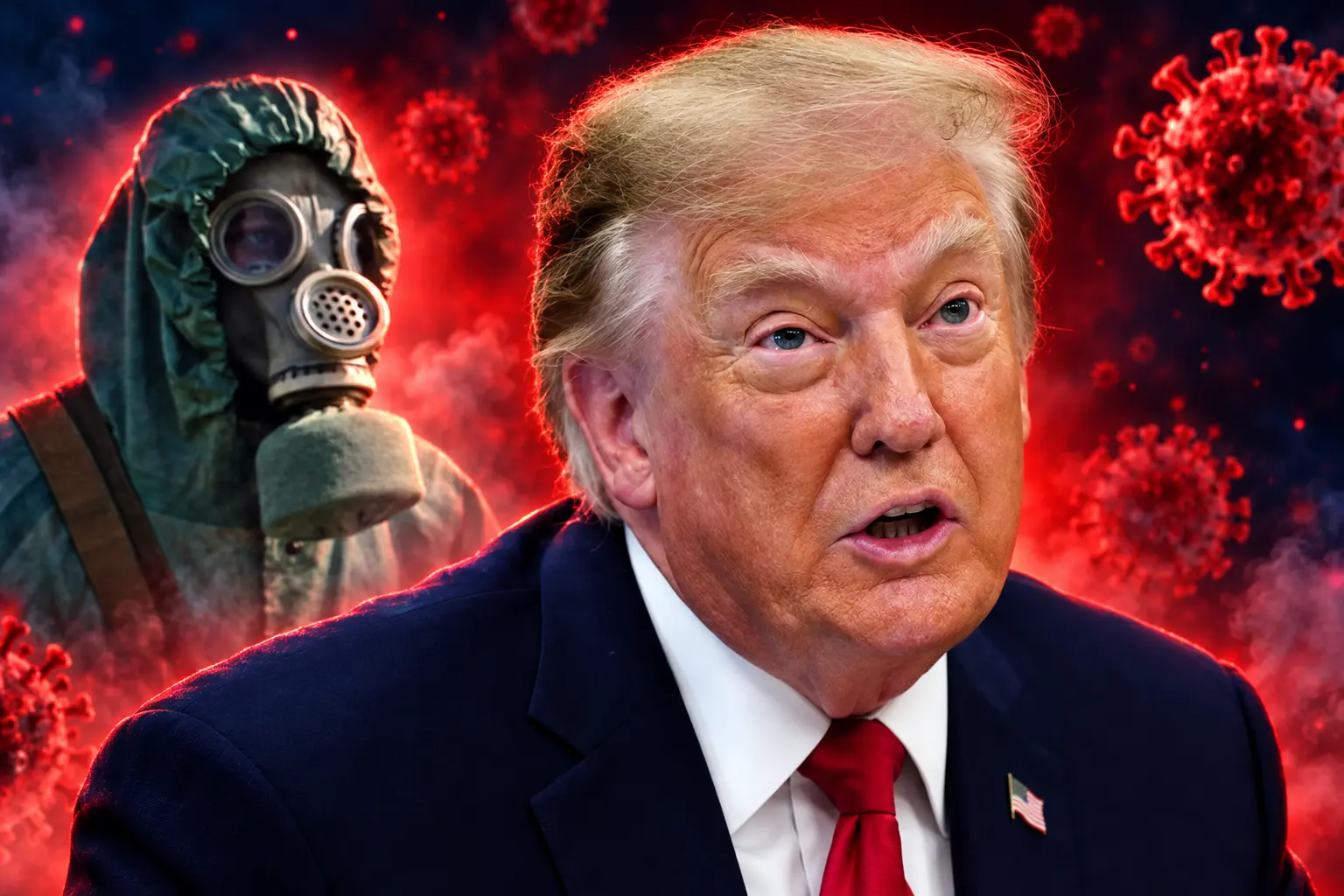
Asked whether a “bio-weapon” was involved, Trump did not wait for a lab printout.
We don’t think so. We’re going to find out soon enough, but we don’t think so.
Donald Trump, U.S. president, Oval Office, October 7
He said Russia insisted the event was under control, then undercut his own reassurance. “If you listen to them, it’s under control. But you know, people have said that before about other things,” he told reporters. He added that China “didn’t say much, and Russia is not saying much either,” while still repeating Moscow’s line that it had the situation “very much under control.”
He said a call with Putin was scheduled and would not give the time. “Today is Vladimir Putin’s birthday,” he added, on the day Putin turned another year older. He also said Russian officials were sharing “a little bit” with U.S. counterparts and that Washington expected them to share “a lot.”
The political temperature in the room was lower than the one at the State Department. Secretary of State Marco Rubio had already said it was “incumbent upon Russia to obviously share more information with the world.” U.S. officials sent a formal demarche reminding Moscow of its duties to pass public-health facts in time. Rubio, speaking earlier in the week, said the case was not “cause for alarm” and was “cause for focus.”
That is a softer charge than a weapons claim, and it is the one Trump chose to take off the table in public. The birthday call does the rest of the work. It keeps the file in the channel he prefers, a leader-to-leader talk, while the labs and the WHO keep asking for a culture result.
The WHO Still Wants the Test Results
Tedros told a briefing on October 7 that WHO had asked Russia for more information on Saturday, a day after the first media reports. Under the International Health Regulations, states must notify WHO within 24 hours of assessing an event that may be a public-health emergency of international concern. Russia’s written reply arrived on Tuesday.
The reply said no plague case had recently been reported in Irkutsk oblast and that about 200 contacts had been placed in quarantine. Tedros said that was not enough. WHO, he said, was unable to conduct a full risk assessment because it did not yet have the full picture.
Since the first media reports, @WHO has been actively following up on the reported death of a laboratory worker at the Irkutsk Antiplague Research Institute in Irkutsk oblast, Russian Federation. The individual died on 2 October 2026 after being hospitalised with severe… pic.twitter.com/1vikwtwVtS
— Tedros Adhanom Ghebreyesus (@DrTedros) October 6, 2026
WHAT GENEVA IS STILL WAITING FOR
- The fatal tests: Which laboratory assays were run on Shipilova, and which pathogens were ruled in or out.
- The trigger: What germ, if any, justified locking down contacts and hospitals in the first place.
- The contacts: A clear account of their health after medical observation ended.
- The second patient: Verification of media reports of another institute employee with pneumonia of undetermined cause.
Maria Van Kerkhove, WHO’s director of epidemic and pandemic management, put the hole in one line: officials still do not understand how Shipilova was infected. If pneumonic plague is excluded, she asked, what did she die from? Tedros said WHO had offered help on plague and on lab biosafety, and that it had received the second-patient claim from two media outlets, including a Russian celebrity site, and could not ignore it.
An earlier WHO estimate, based on the thin file then in hand, put the risk as moderate to low in Irkutsk, low across Russia, and very low in Europe. That snapshot is not the fuller judgement Tedros said he still cannot make.
Plague Scientists Put Epidemic Odds Near Zero
Outside Russia, plague researchers have been blunt about the gap between a tragic lab death and a continental outbreak. Paul Keim, a microbiologist at Northern Arizona University who has worked with former Soviet plague labs, said the worst plausible outcome is a localized cluster. A Science Media Centre note carried by colleagues put the chance of an epidemic at “zero” if contact tracing has been done with ordinary competence.
Pneumonic plague, the form that can pass from person to person on droplets, is brutal when it is missed. Untreated patients decline in days, which also limits how far they walk. Javier Pizarro-Cerda, who leads the Yersinia unit at the Pasteur Institute in Paris, said a worker who has an accident with plague is supposed to report it at once and start antibiotics. If Shipilova died of pneumonic plague after working in that building, he said, that would be “a serious failure.”
The Pasteur Institute, where Alexandre Yersin identified the bacterium in 1894, has had no lab infection in more than 130 years. Lab plague deaths are rare enough that the last widely studied Western case is still Malcolm Casadaban, a University of Chicago geneticist who died in 2009 after working with a weakened strain. He had undiagnosed hemochromatosis, which left extra iron in his blood and let the attenuated bacteria grow.
Keim’s own rule for a scare in Flagstaff is prosaic. A possible exposure means prophylactic antibiotics and a temperature check every hour. In July 2025 a young man in northern Arizona died less than eight hours after arriving at hospital with severe lung disease; once plague was suspected, 46 household members, co-workers and staff received a seven-day course of ciprofloxacin. None of them fell ill. The death was later confirmed as pneumonic plague, likely from sick cats at work.
Between 1,000 and 2,000 human plague cases are typically reported in a year, most of them in Madagascar and the Democratic Republic of the Congo. The bacterium still lives in animals in Siberia, Mongolia, China and the western United States. Pizarro-Cerda called the Irkutsk centre “a very famous place” for that reason, not because a civilian anti-plague lab is itself a weapons plant. Keim said he has toured sister stations in Kazakhstan and Uzbekistan, and that the Irkutsk director, Sergey Balakhonov, has visited his lab in Arizona. After the invasion of Ukraine, he said, those ties “fell apart.”
Russia still uses a live, weakened plague vaccine for people at occupational risk, usually every year, because protection fades. The shot is better understood against bubonic disease than against pneumonic infection. Rospotrebnadzor leaned on that history on October 7, saying Shipilova had been vaccinated and was therefore “immune to the dangerous infections with which she worked.” It still did not name the pneumonia that killed her.
The Soviet Script of Contaminated Meat
The hunger for a weapons story has a pedigree, and so does the official habit of starving it. In April 1979, people began dying of anthrax in Sverdlovsk, now Yekaterinburg. Soviet doctors blamed bad meat. Years later the map of the dead followed the wind from a military plant, Compound 19, not a butcher’s stall. U.S. analysts recorded the 1979 Sverdlovsk anthrax accident as a leak from a facility long suspected of biological-warfare work. At least 66 people died. In 1992, Boris Yeltsin admitted the military source.
Plague sat inside that old programme. CDC treatment guidance published in 2021 notes that Soviet labs in the 1970s and 1980s produced large volumes of antibiotic-resistant plague as a weapon, prepared for release in the air. Marshall Billingslea, a former U.S. presidential envoy, wrote that a 1992 U.S. delegation pressed Moscow on genetic work to make plague harder to treat, and that the former anti-plague network was part of that infrastructure. He said Russia should now say what pathogen killed Shipilova and whether offensive work continues in Irkutsk.
Ashish Jha, who ran the White House COVID response under President Joe Biden, put the rhyme in four words on X: “We’ve been here before.” Andrew Weber, who served as assistant secretary of defense for nuclear, chemical and biological defense programs, said he was “not quite reassured yet by official Russian statements given the history of lying and covering up.” He asked the question the quarantine numbers still leave open: is this an overreaction to one death, or were there more cases than the index patient?
That is not proof that Irkutsk was running a weapons line in 2026. Keim said there is no public evidence the lab was doing gain-of-function work to make plague worse, and no public evidence it is a bioweapons site now. The historical pattern is narrower, and uglier in a smaller way. When a high-containment accident happens in a system that once lied about anthrax, the first week’s vocabulary is always the same: under control, no emergency, false information, nothing to see in the cultures.
What the Quarantine Numbers Do Not Settle
On October 7, Rospotrebnadzor said there was no epidemic risk in Siberia. It said no plague had been found in anyone who had contact with Shipilova, that 90 percent of those placed in quarantine had been released, and that nearly 5,000 lab tests had found no dangerous pathogens. Earlier it said contact testing had turned up two COVID-19 infections and two rhinovirus cases. Anna Popova, who heads the agency, had flown to Irkutsk at the end of the previous week.
Kremlin spokesman Dmitry Peskov said Russia had informed WHO through the proper channel. Asked about a second sick employee, he said “the vast majority of what the media are reporting about this situation is false information” and told reporters to trust the health regulator. Independent checks have not produced a named second death in official Russian notices. WHO asked anyway, because a second pneumonia at the same institute would change the file.
OFFICIAL LINES ON OCTOBER 7
| Voice | What they say happened | What they still will not say |
|---|---|---|
| Rospotrebnadzor | Unknown pneumonia; no work-related germs; no lab emergency; 90 percent of about 200 contacts released after nearly 5,000 tests | The cause of Shipilova’s pneumonia |
| WHO | No plague case registered in the oblast, per Russia’s IHR reply; contacts were observed and tested | How she was infected, and what prompted the controls |
| White House | Not a bioweapon; Russia says it is under control; a Putin call is set | When the call is, and what U.S. agencies have seen |
| CDC | No sign of a broader threat to the United States; plague is treatable with early antibiotics | A confirmed diagnosis from Irkutsk |
CDC Director Erica Schwartz said the risk to the United States was extremely low and that the agency was working with the Department of Homeland Security, the State Department and the Department of War to track anyone arriving from the area. CDC has a port health station at New York’s Kennedy Airport that can screen travellers. The agency’s own account, posted on October 6, said pneumonic plague can spread through close-range droplets and that, at this time, there was no indication of a broader U.S. threat.
WHAT WE KNOW
- The death: A 28-year-old technician at the Irkutsk institute died on October 2 of severe pneumonia that Russia has not explained.
- The response: About 200 contacts were observed; Russia says those measures are ending and that tests found no high-threat pathogens in them.
- The diplomacy: WHO and the United States have asked for the missing lab detail; Trump has taken a bioweapon charge off the public table.
WHAT IS UNCONFIRMED
- The broken tube: Local accounts of a shattered vial on September 25 have not been verified, and the health watchdog denies a pathogen accident.
- A second case: Reports of another employee with unexplained pneumonia remain unverified in official notices.
- Other origin stories: Tales of a Thailand trip or a field visit near Mongolia have no public evidence behind them.
A dropped-tube story filled the empty space because a plague lab, a young woman and a nameless pneumonia will not sit quietly. Online, the accident became a closed hospital list and a mask order at an aluminium plant before any ministry named a bacterium. That is how a personnel file becomes a bioweapon question by the time it reaches the Oval Office.
Putin Gets a Call Instead of a Charge
Trump’s “we don’t think so” is the sentence the Kremlin needed on a birthday. It is also the sentence that leaves WHO in the same place it was on Saturday: waiting for the assays on a dead technician and for a straight account of why 200 people were pulled in. Peskov can call the rest of the coverage false. He cannot, from that podium, produce a cause of death.
The call with Putin, if it happens, will be the place Trump said he would press for more sharing. Until that file includes a pathogen, the weapons scare is politically closed and medically open. Shipilova is still listed as pneumonia of unknown origin, and the institute that employed her still has not said what she handled in her last week at the bench.
Disclaimer: This article is news reporting and analysis of official statements, scientific comment and public-health notices. It is for information only and is not medical advice, a diagnosis, or guidance on plague exposure, antibiotics, vaccines or travel. Readers who have questions about symptoms, contacts or preventive treatment should consult a licensed physician or a local public-health department. Figures, quarantine counts and official statuses reflect the statements cited as of the dates given and can change as laboratory results are released.

The Wilderness Croajingolong Protects Is a Colonial Fuel Load

Trump Rules Out a Bioweapon as Moscow Hides the Germ

Eva Marie Saint, Last Waterfront Witness, Dies at 102

Luminar’s Full Editor Comes Free for a Year on Googlebook

Sicario 3 Advances After the Original Stars Pick the Team

Sharon AI Walks an $8.8 Billion Book Into Goldman

Congo Rolls Out Ervebo Against a Different Ebola Virus

Cash Still Buys Nearly One in Three U.S. Homes

The Agent Harness Turns Safety Into Switching Cost

Align Research Prices Legal AI at $100 a Job
-
 NEWS1 month ago
Sharon AI Walks an $8.8 Billion Book Into Goldman
-
 LIFESTYLE1 month ago
Congo Rolls Out Ervebo Against a Different Ebola Virus
-
 BUSINESS1 month ago
Cash Still Buys Nearly One in Three U.S. Homes
-
 NEWS1 month ago
The Agent Harness Turns Safety Into Switching Cost
-
 NEWS1 month ago
Tropical Storm Edouard Left Houston Open and Beaumont Dark
-

 NEWS1 month ago
Nationwide Bets on Data Work Before It Trusts Agents
-
 NEWS4 weeks ago
Align Research Prices Legal AI at $100 a Job
-
 NEWS1 month ago
CDC Holds Pennsylvania Measles Deaths Off the U.S. Tally