
NEWS
NASA Collects Clachtoll Rocks to Read Mars Reduction Spots
NASA’s Goddard team bagged 1.2-billion-year-old Clachtoll reduction spots so labs can finish a Jezero test the rover arm left open.

In summer 2026, NASA scientists collected 1.2-billion-year-old red sandstone at Clachtoll to finish a test Perseverance could not complete on Mars. The Goddard Instrument Field Team bagged gray-green reduction spots from the Stoer formation after the rover found similar stains in Jezero Crater.
Those Earth samples are already in labs. The Mars cores that raised the same question are not.
The Green Spots Perseverance Could Not Finish
In July 2024, Perseverance stopped at an arrowhead-shaped rock in Jezero Crater nicknamed Cheyava Falls, in the Bright Angel outcrops along Neretva Vallis. PIXL and SHERLOC, the arm-mounted chemistry tools, found colorful spots in clay- and silt-rich rock that also held organic carbon, sulfur, rusted iron, and phosphorus.
Higher-resolution maps showed mineral rings the team called leopard spots, with vivianite and greigite. On Earth those minerals often sit near rotting organic matter, and some microbes make greigite, but heat, acid, or non-living chemistry can make them too. Bright Angel lacks a clear high-heat or acid overprint, which is why NASA later described potential biosignatures in Sapphire Canyon, the core drilled from that rock, as a finding that still needs more data.
Astrobiological claims, particularly those related to the potential discovery of past extraterrestrial life, require extraordinary evidence.
Katie Stack Morgan, Perseverance project scientist, NASA news release
Joel Hurowitz of Stony Brook University, lead author of the peer-reviewed Cheyava Falls study, said the Bright Angel chemistry could have fed microbial metabolisms, then added that seeing those signatures was not the same as having a biosignature. Nicky Fox, associate administrator for NASA’s Science Mission Directorate, said the published data are now open for other labs to confirm or refute that biological potential. Sapphire Canyon is one of 27 rock cores Perseverance has sealed since it landed.
A few weeks after Bright Angel, the rover reached red rocks at Serpentine Rapids and abraded Wallace Butte. Adrian Broz, then writing for the rover science team, described green spots at Serpentine Rapids with dark cores and fuzzy rims. The arm holding SHERLOC and PIXL could not sit safely on those spots, so their makeup stayed unknown. That is the gap the Scottish trip was built to close.
FROM JEZERO TO THE HIGHLANDS
- July 2024: Perseverance finds leopard spots on Cheyava Falls and later drills the Sapphire Canyon core.
- August 19, 2024: The rover abrades Wallace Butte at Serpentine Rapids and photographs green spots it cannot scan with the arm instruments.
- September 10, 2025: A Nature paper reports the Cheyava Falls sample as a potential biosignature.
- Summer 2026: The Goddard Instrument Field Team collects reduction-spot sandstone at Clachtoll and the Bay of Stoer.
- September 29, 2026: NASA says those samples are home and headed into labs that cannot fly on a rover.
Perseverance has also mapped carbonates that formed in Jezero groundwater along the crater’s edge, a separate water record from the same basin. The Clachtoll bags are aimed at a narrower problem: what a green stain in red sediment actually is when you can cut it open.
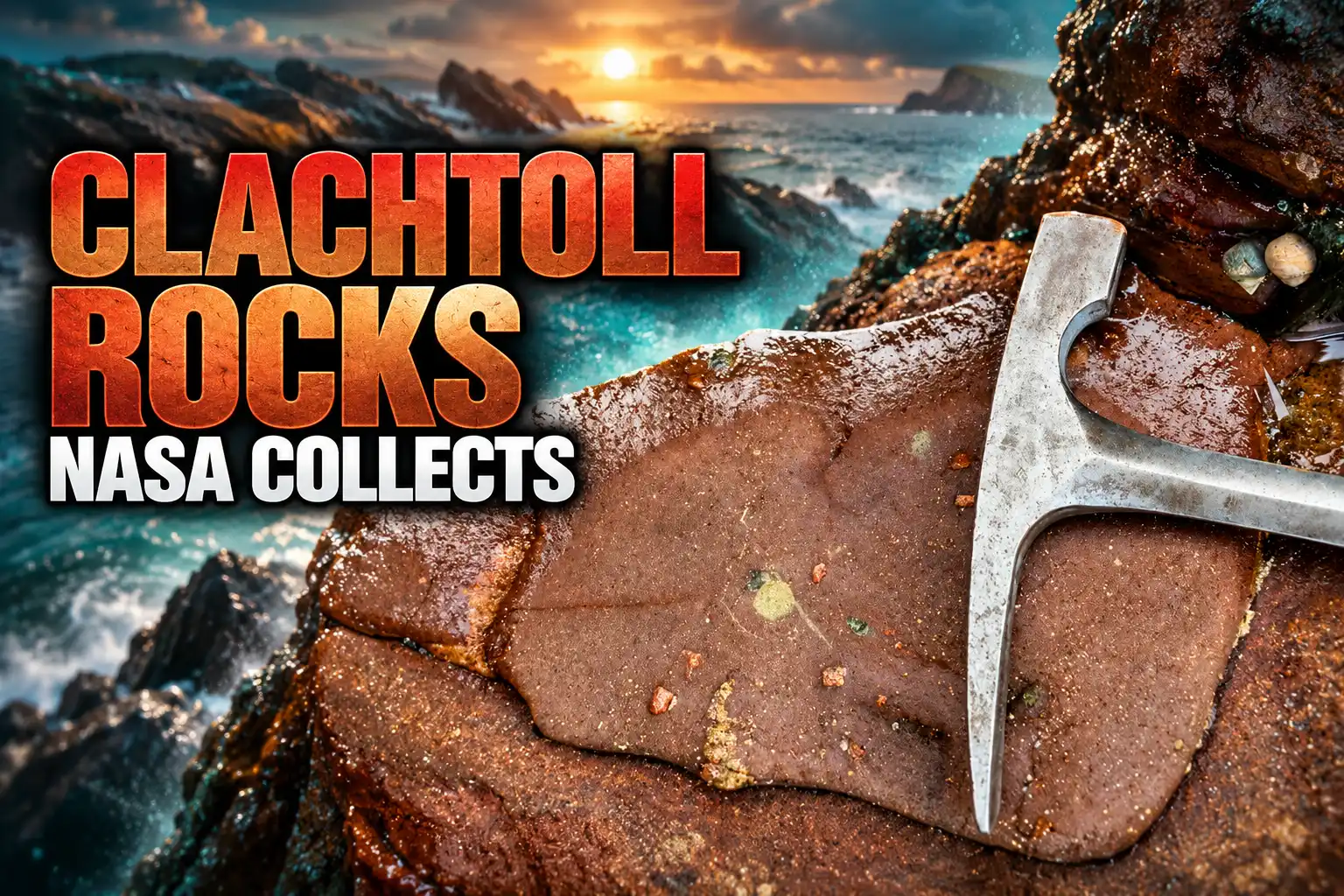
Clachtoll Opens Only Between the Tides
Field lead Mike Thorpe of NASA’s Goddard Space Flight Center worked the Bay of Stoer with Amy McAdam and Fuen Cañadas Blasco while Broz, now listed with Purdue University, scanned the same cliffs for reduction spots. Deputy field lead Hemani Kalucha held sampled blocks at Clachtoll Bay. The water at that worksite moves 11 to 15 feet with the tide, and a tidepool sat on the cliff in NASA’s own photographs.
GIFT hiked the coasts and cliffs of the Clachtoll region with handheld instruments on their backs. Climbs had to hit the rocks between high tides and get off while the slopes were still dry, a tight window in a wet Highland summer. On the spot they checked mineral and chemical makeup, then chose blocks for the lab.
THE CLACHTOLL FIELD CONSTRAINTS
- Tide window: Work sites rise and fall 11 to 15 feet, so the team timed climbs between high water.
- Tools on the cliff: Handheld instruments gave mineral and chemical readings before any bag was filled.
- Sample status: By 29 September 2026, NASA said the rocks were home and ready for instruments that stay in buildings.
That field work is the unglamorous half of analog science. It is also the half a rover cannot copy. Perseverance can abrade a patch and park a sensor. It cannot chase a falling tide, split a block, or send the same stone through a bench of machines the next month.
Searching for clues about Mars’ ancient past… right here on Earth.
Our Perseverance rover found greenish "reduction spots" on Mars. On Earth, spots like these can be formed by microbes, so NASA scientists headed to Scotland to take a closer look.https://t.co/Uk88kue5yT pic.twitter.com/D1mjOwt5ku
— NASA Solar System (@NASASolarSystem) September 29, 2026
NASA Solar System posted those expedition stills on 29 September 2026, the same day the field blog went up. The pictures show the spotted red beds, the tide line, and the people who had to beat the water. Going to Scotland first, instead of staging another life-on-Mars night, is the lesson left over from the 1996 meteorite claim that spent years coming apart. The Clachtoll trip is that slower test.
Why These 1.2-Billion-Year-Old Beds Matter
The Stoer formation is useful because two things sit in the same cliffs. The rocks formed in lakes and rivers, the same class of setting Jezero once had, and they hold evidence of microbial life from 1.2 billion years ago, before land plants. NASA called that overlap hard to find on Earth and ideal for people who have to read rover data.
Mars is dry now, but both planets keep layered mudstones and siltstones rich in clay. Learning how old life shows up in Scottish cliffs is meant to show how a biosignature might be preserved, and how a rover might miss it. The same work, NASA said, can fill holes in Earth’s own geologic record.
STOER BEDS VERSUS JEZERO ROCKS
| Test | Stoer cliffs, Scotland | Jezero Crater, Mars |
|---|---|---|
| Setting | Ancient lakes and rivers in red sandstone | Ancient lake and river rocks, including red beds |
| Target stain | Gray-green reduction spots in hand sample | Leopard spots at Cheyava Falls; green spots at Serpentine Rapids |
| What can be done now | Collect, ship, and run full laboratory instruments | Abrade, scan with PIXL and SHERLOC, cache cores |
| Hard stop | Tides and wet slopes | The rover arm could not sit on the Serpentine green spots |
Age is the awkward part of the analog. The Scottish beds are 1.2 billion years old. Jezero’s wet chapter is described in billions of years, far older than Stoer. NASA is not claiming the clocks match. It is claiming the environment and the stain type are close enough to teach the chemistry of a red bed that later turned green.
Microbes Are Only One Way to Bleach Red Rock
Reduction spots are gray-green patches in otherwise red sandstone. NASA’s field blog is blunt: they can mark ancient microbes interacting with rock, and they can form in other ways. Broz’s Serpentine note laid out the same fork for Mars. Red beds get their color from oxidized iron. A later reducing fluid bleaches a patch to green when that iron switches state.
THREE WAYS A RED BED TURNS GREEN
- Living cells: Microbes can drive the iron-reduction reaction that strips the red color.
- Dead organics: Decaying organic matter can set up a local reducing zone with no living colony required at the moment of bleaching.
- Sulfur and iron: Reactions between sulfur and iron can create reducing conditions with no microbes in the story at all.
That fork is why a bag of Clachtoll stone is worth more than another rover photograph. On Earth, researchers can cut the spot, map its core, and ask whether a metal-rich nucleus, a microbial fabric, or a sterile chemical front made it. A 2019 study of possible stromatolites at Clachtoll, led by A. T. Brasier and posted through the University of Glasgow, concluded the laminated rocks in those thin sections were better read as stromatolite-like sediment, not proven mats. Even with saws and isotopes, the Highland rocks still argue.
A separate 2026 laboratory paper led by Sean McMahon reported bleached spots forming within weeks in inoculated sand-ferrihydrite slurries, and not in sterile controls, with iron-reducing bacteria abundant in the pale zones. That result backs the long-running idea that microbes can make visible reduction spots. It does not retire the non-living paths Broz listed for Jezero. The Scottish collection is how NASA puts those paths next to one another on the same bench.
GIFT Took the Rocks Where Rovers Cannot
GIFT is based at NASA’s Goddard Space Flight Center in Greenbelt, Maryland. The team exists to work Earth’s hard ground as a stand-in for other worlds, then feed what it learns into instruments and rover plans. Caela Barry of Goddard wrote the expedition account. Pedro Cota shot the field photographs.
At Split Rock the group stood in two rows: Cota, Dina Bower, McAdam, Cañadas Blasco, Kalucha, Thorpe, and S. J. Ralston of NASA’s Johnson Space Center in front; Jessie Wilde of Goddard, Alex Jones, Broz, William McMahon, David Davis, and Zachary Dickeson behind. Johnson joined a university list that NASA named in full.
THE GROUPS ON THE SCOTLAND TRIP
- NASA Goddard: GIFT led the campaign, including Thorpe, Kalucha, McAdam, Cañadas Blasco, Bower, Wilde, and Cota.
- NASA Johnson: Houston sent field support, with Ralston in the Split Rock photograph.
- Universities: Glasgow, Maryland, Purdue, Stony Brook, and Cambridge are listed as collaborators on the expedition.
Broz’s presence ties the Highland bags to the unread Mars spots. He wrote the Serpentine Rapids note when the rover arm could not land on a green stain, then stood on Scottish cliffs looking for the Earth version. Stony Brook, Hurowitz’s home lab, is on the collaborator list even though Hurowitz is not named in the Split Rock caption. The coalition is built so the people who have to interpret Jezero can break open a rock that formed in water, turned red, then grew green spots.
Analog Work Will Not Close the Mars Question
NASA’s own close on the trip is modest. Follow-on work is meant to improve how teams read Mars data, help plan new rover investigations, and prepare scientists for potential Martian sample analysis later. It does not claim Clachtoll will settle Cheyava Falls. Leopard spots with vivianite and greigite are not the same object as a gray-green reduction stain in Torridonian-age sandstone, and the Scottish clock is younger than Jezero’s lake.
What the analog can do is narrower, and still useful. Labs can grind, etch, and image Stoer spots with tools that will never ride on Perseverance. They can compare a spot that formed with microbes to one that formed without them, then ask which measurements a rover already has, and which ones it still lacks. That is how you keep a potential biosignature from hardening into a headline it cannot carry.
The boxes are in buildings now. The cliffs at Clachtoll will take another tide tonight, and the green rings in the red stone on Mars will sit where the rover left them.
Frequently Asked Questions
What is a potential biosignature on Mars?
NASA defines a potential biosignature as a substance or structure that might have a biological origin but still needs more data before anyone can say life was, or was not, present. The agency also uses a Confidence of Life Detection scale with seven benchmarks to keep that claim from jumping a grade it has not earned.
How big is the Cheyava Falls rock Perseverance studied?
NASA measured Cheyava Falls at 3.2 feet by 2 feet, or 1 meter by 0.6 meters, an arrowhead-shaped block in the Bright Angel formation. The rover photographed it in July 2024 before drilling the Sapphire Canyon core from the same target.
What did the Wallace Butte abrasion at Serpentine Rapids show?
The abrasion patch is 5 centimeters across, about 2 inches, and one of the green spots in the nighttime mosaic is about 2 millimeters across, about 0.08 inch. Perseverance acquired that mosaic on 19 August 2024, sol 1243, with the SHERLOC WATSON camera.
How wide is Neretva Vallis in Jezero Crater?
NASA describes Neretva Vallis as an ancient river valley a quarter-mile, or 400 meters, wide that once carried water into Jezero Crater. Bright Angel sits on the northern and southern edges of that valley, which is where Perseverance found Cheyava Falls.
When did Perseverance land, and when was GIFT formed?
Perseverance landed in Jezero Crater in February 2021. The Goddard Instrument Field Team was put together in 2009 as a Goddard facility that takes instruments into analog terrain so later flown tools are designed against real rock, not only against a lab bench.

EU Opens a 14-Day Fight Over Unused Game Gold

FDA Closes Record Cyclospora Outbreak Probe With No Pathway

Anker and Jackery Sales Close Before Prime Big Deal Days

Households Added 406,000 Jobs as Payrolls Barely Rose

SEC Opens a Crypto Custody Path Congress Did Not

Sharon AI Walks an $8.8 Billion Book Into Goldman

The Agent Harness Turns Safety Into Switching Cost

Cash Still Buys Nearly One in Three U.S. Homes

Copper’s Longest Rally Since 1994 Sits in U.S. Warehouses

Tropical Storm Edouard Left Houston Open and Beaumont Dark
-
 NEWS4 weeks ago
Sharon AI Walks an $8.8 Billion Book Into Goldman
-
 NEWS4 weeks ago
The Agent Harness Turns Safety Into Switching Cost
-
 BUSINESS1 month ago
Cash Still Buys Nearly One in Three U.S. Homes
-
 BUSINESS4 weeks ago
Copper’s Longest Rally Since 1994 Sits in U.S. Warehouses
-
 NEWS1 month ago
Tropical Storm Edouard Left Houston Open and Beaumont Dark
-

 LIFESTYLE1 month ago
Congo Rolls Out Ervebo Against a Different Ebola Virus
-

 NEWS1 month ago
CDC Holds Pennsylvania Measles Deaths Off the U.S. Tally
-

 NEWS4 weeks ago
Nationwide Bets on Data Work Before It Trusts Agents