
NEWS
Sharon AI Walks an $8.8 Billion Book Into Goldman
Sharon AI is on a four-stop bank circuit after selling $8.8 billion of GPU contracts against $1.9 million of quarterly revenue and a $1.6 billion June raise.

Sharon AI is sending management through four investor conferences in September, starting with Goldman Sachs in San Francisco on September 8. The Nasdaq-listed Australian neocloud, ticker SHAZ, then goes to Citi in New York on September 10. CLSA in Hong Kong follows on September 23 and 24, then RBC Capital Markets in Chicago on September 29 and 30.
The dates read like a standard investor-relations note. The ledgers do not. Sharon AI is carrying $8.8 billion of contracted work and posted $1.9 million of revenue in the quarter ended June 30.
Goldman First, Then New York, Hong Kong and Chicago
SharonAI Holdings Inc. said members of its management team will take part in the Goldman Sachs Communacopia + Technology Conference on September 8, the Citi 2026 Global TMT Conference two days later, the CLSA 33rd Investors Forum in Hong Kong, and the RBC Capital Markets Global Communications Infrastructure Conference at the end of the month. The company told investors to go through their conference contacts. It did not name a public webcast or a speaking slot.
CoreWeave, the much larger U.S. GPU cloud, is on that Goldman slate the same day. Chief executive Michael Intrator is scheduled to present at the same Goldman conference at 4:45 p.m. Eastern on September 8, with a live webcast. Sharon AI is still the smaller name in that room, and it is there as a participant, not as the billed speaker.
THE SEPTEMBER CIRCUIT
| Stop | City | Dates |
|---|---|---|
| Goldman Sachs Communacopia + Technology | San Francisco | September 8 |
| Citi Global TMT | New York | September 10 |
| CLSA 33rd Investors Forum | Hong Kong | September 23-24 |
| RBC Global Communications Infrastructure | Chicago | September 29-30 |
Hong Kong is the APAC leg of a U.S. listing. Chicago is a communications-infrastructure audience that already knows towers, fiber and data halls, and is now being asked to underwrite GPU clouds as well.
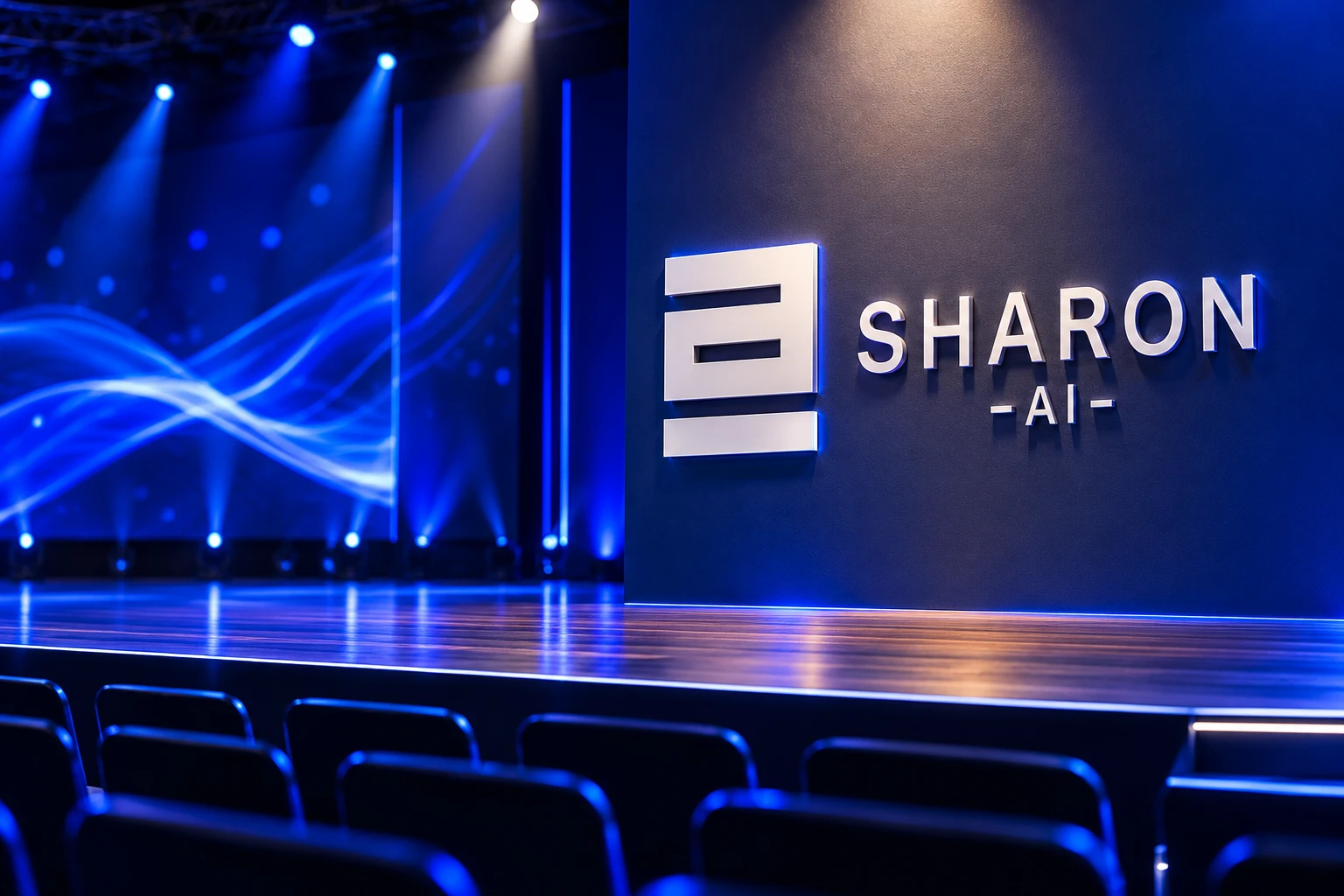
$8.8 Billion Sold Against a $1.9 Million Quarter
The company’s second-quarter results posted August 6 are the reason the roadshow has something to talk about, and the reason it has something to defend. Total contract value stood at $8.8 billion as of that date. Revenue for the quarter ended June 30 was $1.9 million, up 412% from $376,984 a year earlier. Adjusted EBITDA flipped to $0.6 million from a $1.7 million loss. The GAAP loss was $430.4 million, including $423.8 million of non-cash items and a $400.4 million fair-value hit on convertible notes after the share price rose.
Co-founder and chief executive James Manning told the earnings call that the quarter raised the three inputs the business needs: factory capacity, contracted demand, and capital. Three months earlier the book was about 100 megawatts and $2.2 billion of contract value. Secured capacity has more than doubled. The contracted book has grown about four times.
THE BOOK VERSUS THE P&L
- Contracted work: $8.8 billion of total contract value as of August 6, an operating metric, not GAAP revenue.
- Quarterly sales: $1.9 million in the second quarter, with Manning saying revenue should ramp from the third quarter of 2026 through 2027.
- Cash on hand: $1.9 billion at June 30, against $26.3 million of property and equipment and $302.6 million of equipment, software and lease prepayments.
- Power locked in: 212 megawatts of secured AI factory capacity, of which 120 megawatts is already contracted, leaving 92 megawatts still to sell.
That gap is the whole pitch. The company is selling multi-year take-or-pay compute into Australian and New Zealand halls, then converting those papers into live clusters. Until the racks are hot, the income statement stays tiny next to the backlog, and the cash pile is a build fund rather than a profit store.
In the second quarter, we established the commercial, infrastructure, and capital foundations for Sharon AI’s next phase of growth at scale.
James Manning, Co-Founder and Chief Executive Officer, August 6 earnings release
Shares closed at $55.94 on September 4, with a market value of $2.00 billion. That is above the February listing price and below the $68.73 June placement price. Anyone sitting in a Goldman or Citi meeting already knows both prints.
How the $1.6 Billion Round Was Built
Sharon AI did not arrive on Nasdaq as a mature cloud. It closed a merger with Roth CH Holdings on December 17, 2025, traded on the OTC market as SHAZ, then listed on the Nasdaq Capital Market on February 18. The company priced 4,166,666 shares at $30.00 that day for about $125 million of gross proceeds, led by funds managed by Oaktree Capital Management and Two Seas Capital, with Lucid Capital Markets as sole bookrunner. Net proceeds were about $118.91 million, earmarked for GPU equipment and working capital. A December 2025 pre-listing round had already brought in $103 million of unsecured convertible notes.
The heavier check came in June. After a $350 million issue of 6.00% convertible notes due 2031 in April, the company closed an oversubscribed $1.6 billion private placement in June, split between about $900 million of common stock and pre-funded warrants and $700 million of 4.75% convertible senior notes due June 15, 2032. Common shares in that deal went out at $68.73. The notes convert at about $99.66, a 45% premium. Situational Awareness and Oaktree anchored the round. Goldman Sachs & Co. LLC was lead placement agent. Lucid was also a placement agent, and Macquarie Capital advised.
THE CAPITAL CALENDAR SINCE DECEMBER
- December 17, 2025: Merger with Roth CH Holdings closes and the stock starts as SHAZ on OTC.
- February 18, 2026: Nasdaq listing and $125 million offering at $30.00 a share.
- April 26, 2026: $350 million of 6.00% convertible notes due 2031.
- June 17, 2026: $1.6 billion placement, Goldman as lead agent, proceeds tied to the NVIDIA build.
- August 6, 2026: Second-quarter results, $1.9 billion of cash, $8.8 billion of contract value.
Manning said the firm has raised about $2.2 billion since December 2025, including $74 million from selling its stake in Texas Critical Data Centers. At June 30 it still had $1.01 billion of convertible notes on the balance sheet as a current liability, which is why a rising share price can print a huge non-cash loss. New money is not free. It arrives with conversion math attached.
Goldman taking the company into Communacopia after running the June placement is not a random IR booking. The same desk that placed the stock is now putting management in front of the next group of buyers, twelve weeks after that deal and well before most of the contracted megawatts are earning.
A Cloud Cut for NVIDIA, Colocation for NEXTDC
The June financing was written against a six-year compute collaboration with NVIDIA signed around June 8. The two companies are adding 72 megawatts of new Australian capacity and scaling up to 40,000 Grace Blackwell GB300 GPUs on NVIDIA’s DSX factory design. Sharon AI’s second-quarter pack put that collaboration at $4.9 billion of contract value.
The structure is a revenue share, not a cash purchase of a full GPU fleet. Sharon AI sells NVIDIA-powered cloud services. NVIDIA takes product revenue and a share of cloud revenue on the supported capacity. Manning said on the August 6 call that the company keeps 100% of the anchor price and shares incremental revenue above that floor. That is how a neocloud with $26.3 million of plant can talk about tens of thousands of next-generation GPUs.
At the December 31, 2025 balance-sheet date the live fleet was 411 GPUs. The mid-2027 target is more than 64,000 NVIDIA units, after an earlier 55,000 figure that sat with the 132-megawatt plan. Storage is being sized ahead of that. A VAST Data expansion commits 600 petabytes, which the company says can stand behind about 100,000 GPUs.
The halls are mostly rented. NEXTDC is the primary colocation partner, with an expansion path of up to 87 megawatts across Melbourne and Sydney, and the company also uses GreenSquareDC and Equinix sites in Sydney. Manning’s argument is that putting clusters into existing Tier III and Tier IV rooms is faster and cheaper than pouring concrete. It also means the build timetable belongs partly to the landlord and the grid, not only to Sharon AI.
What Institutions Will Test in Private Meetings
The $8.8 billion figure is a stack of take-or-pay papers. Take-or-pay means the customer pays for reserved capacity whether or not it uses the hours. That is attractive in a slide deck. It is only as hard as the name on the invoice.
THE LIVE CONTRACT FILE
- NVIDIA collaboration: $4.9 billion over six years, 72 megawatts, up to 40,000 GB300 GPUs.
- Global AI lab: $1.32 billion over five years, the contract Manning used to justify a New Zealand site.
- Global technology company: $950 million over five years, with a first cluster already handed over in August.
- ESDS Software Solutions: $1.26 billion over five years, signed in the first quarter for thousands of GPUs in Australia.
- Global AI platform: $373 million over five years for 2,048 Blackwell Ultra B300 GPUs, at more than $4 per GPU-hour, with revenue slated for the first quarter of 2027.
Canva and GMI Computing were named as early 2026 customers in the company’s first-quarter pack. Several of the larger later deals still hide behind “global” labels. That is the first question in a one-on-one: who actually pays, in which currency, and with what credit support.
The ESDS paper is the one outside investors have already picked at. It is a five-year take-or-pay for Australian GPUs that an Indian cloud company is meant to resell. If that buyer cannot fill the hours, the contract still says pay. Whether it can pay, and whether Sharon AI can finance the $800 million-class capex that kind of cluster implies, is exactly the sort of credit work a Citi TMT book or an RBC infrastructure session is built for. A take-or-pay line on a slide is not the same thing as cash in the door.
Manning’s own scarcity list is GPUs, power, and data residency. Manufacturing queues and hyperscaler demand still ration chips. Ready halls with dense power are scarce. Australian and New Zealand residency is the product feature for regulated customers who will not send training data to Virginia. Those are fair points. They are also the constraints that can slip a Q4 2026 ramp into 2027.
An Initial Deployment Is In, the Rest Is a Schedule
On August 20 the company said it had delivered an initial AI cloud deployment for the global technology customer on that $950 million contract, the first phase of a five-year deal, with more NVIDIA clusters due in Australia in the following months. That is the first public sign the backlog can turn into running kit, not only into press releases.
The $373 million B300 job is still a 2027 revenue item. The NVIDIA GB300 factory is a multi-year install. Manning told the August 6 call that material revenue from the large B300 and GB300 deployments is a fourth-quarter 2026 story, and that the risk list is hardware delivery and data-center readiness. He also said the firm is already hearing demand for NVIDIA’s next architecture, Vera Rubin, for late 2027 and 2028. Selling the next generation before this one is fully lit is how this trade works. It is also how a backlog stays a backlog.
Governance has been restacked around that delivery problem. Andrew Penn AO is non-executive chairman. Anuj Goel, formerly of Macquarie Group, is chief financial officer. Melissa Anastasiou is chief legal officer. In late August the company added David Burns as chief operating officer and moved co-founder Andrew Leece to head of strategic partnerships. Those hires read as a builder’s org chart, not a research lab’s.
Rafay’s Layer and a Book That Still Has to Turn On
On September 4, four days before the Goldman stop, Sharon AI said it had signed a five-year deal with Rafay Systems to run orchestration across its AI factory sites. The Rafay platform is meant to be the common control layer for provisioning, governance and customer delivery as the company adds halls. The architecture is designed to orchestrate up to 150,000 GPUs over the term, a figure that sits well above the 64,000-unit mid-2027 hardware target and tells you how management wants the platform talked about in a bank meeting.
Sharon AI has entered a five-year strategic agreement with @rafaysystemsinc to standardise orchestration and operations across our AI Factory environments.
The Rafay Platform becomes our centralised control layer, standardising how compute is provisioned, governed, monitored… pic.twitter.com/u2Cf2o0Uqi
— Sharon AI, Inc (@sharon__ai) September 4, 2026
Manning’s line on that deal was operational, not promotional. He said a single platform should let the company run capacity more efficiently and give customers a consistent experience as the footprint grows. Software will not install the GB300s. It is what the company wants to show once they are in the rack, so a customer in Sydney and a customer in Auckland see the same cloud rather than a pile of one-off clusters.
By the time the RBC meetings open in Chicago on September 29, the third quarter will be almost closed. That is the first period Manning flagged for a real revenue ramp. The people in those rooms already wrote, or passed on, the June paper at $68.73. They do not need another tour of the conference list. They need to know which of the $8.8 billion of contracts is on the floor, which is still a purchase order for a chip that has not shipped, and which depends on a buyer whose own bill is bigger than its history.
Disclaimer: This article is news reporting and analysis of Sharon AI’s conference schedule, contracts and published financials, and it is for information only. It is not investment advice, a solicitation to buy or sell SHAZ or any other security, or a recommendation of any offering, note or warrant. Readers should consult a licensed financial adviser or other qualified investment professional before making any decision about these shares or related instruments. Figures, contract values, capacity targets and conference plans are taken from company statements and market data as published and can change with later filings, deliveries or deal changes.

The Wilderness Croajingolong Protects Is a Colonial Fuel Load

Trump Rules Out a Bioweapon as Moscow Hides the Germ

Eva Marie Saint, Last Waterfront Witness, Dies at 102

Luminar’s Full Editor Comes Free for a Year on Googlebook

Sicario 3 Advances After the Original Stars Pick the Team

Sharon AI Walks an $8.8 Billion Book Into Goldman

Cash Still Buys Nearly One in Three U.S. Homes

The Agent Harness Turns Safety Into Switching Cost

Congo Rolls Out Ervebo Against a Different Ebola Virus

CDC Holds Pennsylvania Measles Deaths Off the U.S. Tally
-
 BUSINESS2 months ago
Cash Still Buys Nearly One in Three U.S. Homes
-
 NEWS2 months ago
The Agent Harness Turns Safety Into Switching Cost
-
 LIFESTYLE2 months ago
Congo Rolls Out Ervebo Against a Different Ebola Virus
-
 NEWS2 months ago
CDC Holds Pennsylvania Measles Deaths Off the U.S. Tally
-
 NEWS2 months ago
Tropical Storm Edouard Left Houston Open and Beaumont Dark
-
 NEWS2 months ago
Nationwide Bets on Data Work Before It Trusts Agents
-

 BUSINESS2 months ago
Copper’s Longest Rally Since 1994 Sits in U.S. Warehouses
-

 NEWS2 months ago
Align Research Prices Legal AI at $100 a Job