
NEWS
Patients Using Health Chatbots Are Redefining Clinical Expertise
KFF finds 32 percent of adults already ask chatbots for health advice, often with no follow-up, while Google’s co-clinician work stays in the lab.

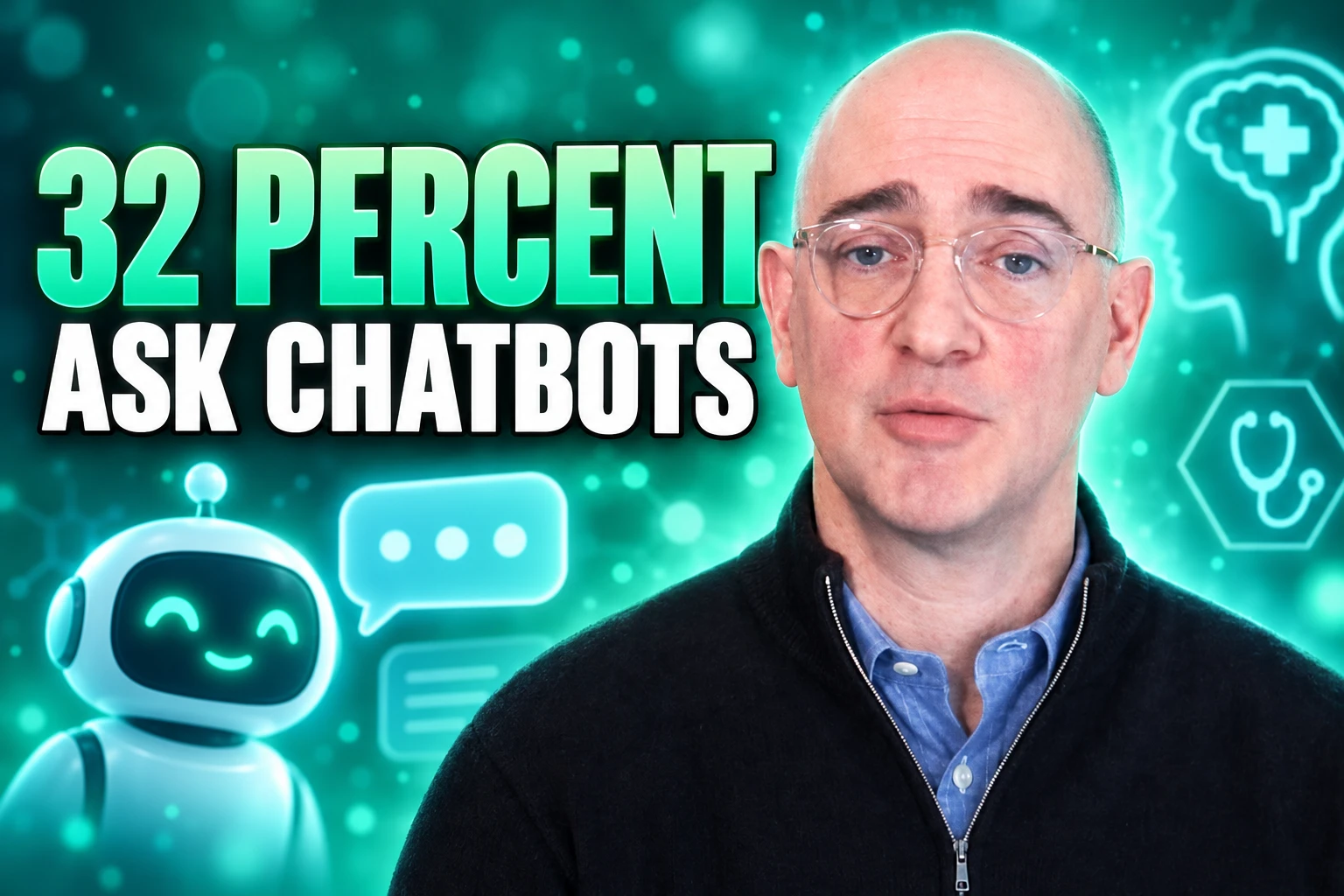
32 percent of U.S. adults used an AI chatbot for health advice in the past year, a KFF poll found. Many of those users never followed up with a clinician.
On August 28, 2026, Peter Clardy, M.D., of Google Health told Cleveland Clinic’s AI Summit that this third party is already inside the visit, and that clinical expertise has not been redefined to match it.
A Third Party Already in the Exam Room
Clardy is a pulmonary and critical care physician and director of the Clinical Enterprise Team at Google Health in New York. He spoke in conversation with Jame Abraham, M.D., chair of hematology and medical oncology at Cleveland Clinic and one of the summit’s organizers. Cleveland Clinic, working with the College of Healthcare Information Management Executives, put the day-long program at the InterContinental Hotel and reported more than 900 registered attendees in person and online.
He described an “epistemic shift” in how clinicians handle a flood of data, how patients look for answers, and what the job of being an expert now means. “We find ourselves collectively in this situation of too much data, not enough information,” he said. Medical training still teaches doctors to become strong pattern recognizers, he argued, while the mix of signs they must read has gone multimodal and much larger.
Abraham told the room that AI can change how patients are treated, how future clinicians are taught, and how research moves. Clardy’s sharper point was smaller. Hospitals still argue about change management and low-risk pilots. Patients did not wait for those pilots.
A Third of Adults Now Ask a Chatbot
KFF’s Tracking Poll on Health Information and Trust, fielded February 24 to March 2, 2026 among 1,343 U.S. adults, found that 32 percent of adults nationally had turned to an AI chatbot for health information in the past year. That share included 29 percent who asked about physical health and 16 percent who asked about mental health. The margin of sampling error was plus or minus 3 percentage points.
Pew Research Center asked a different question a few months later and got a related, not identical, number. In a survey of 3,488 U.S. adults from June 22 to 28, 2026, 34 percent said they ever use AI chatbots for at least one of eight health reasons Pew listed. That is lifetime use across a menu of tasks, not KFF’s past-year snapshot, and the two figures should not be averaged.
THE TWO NATIONAL READS ON HEALTH CHATBOTS
| Survey | Field dates | Share using AI for health | What that number measures |
|---|---|---|---|
| KFF | Feb. 24-Mar. 2, 2026 | 32 percent | Past-year use for health information |
| Pew Research Center | June 22-28, 2026 | 34 percent | Ever used a chatbot for at least one of eight health reasons |
Younger adults drive both counts. KFF found that adults under 30 used AI for mental health information at 28 percent, against 8 percent among adults 50 and older. Uninsured adults used it for mental health at 30 percent, against 14 percent among those with insurance. Pew found chatbot health use at 44 percent among ages 18 to 29 and 17 percent among adults 65 and older, and 56 percent among Asian adults in its English-speaking sample.
The visit Clardy called triadic is already happening in private, on phones, before anyone sits down in clinic.
Why Cost and Wait Times Drive the Shift
Among KFF’s chatbot health users, 65 percent said a major reason was getting quick or immediate information. 41 percent wanted to look something up before deciding whether to see a provider. 36 percent felt more comfortable looking up health information privately. Cost and access sat underneath those answers: 19 percent named not being able to afford a professional as a major reason, and 18 percent named not having a regular doctor or not getting an appointment. Under age 30 those shares rose to 29 percent for cost and 38 percent for access. Users earning less than $40,000 a year named cost at 32 percent and access at 25 percent.
Clardy tied that pattern to a line he took from a National Academy of Medicine discussion on trust and innovation. A patient advocate had said that “innovation in health care moves at the speed of desperation.” He treated that as a warning, not a slogan. Everyone, he said, needs an advocate and a wayfinder when they manage their own health, and the profession is learning from how people already use these tools.
I think the dichotomy between trust and desperation comes when you think about how everyone needs an advocate and a wayfinder when it comes to managing their own health.
Peter Clardy, M.D., Director of the Clinical Enterprise Team, Google Health
Pew’s June survey shows what that wayfinding looks like when no one is watching. 28 percent of U.S. adults said they use chatbots to get health information quickly. 25 percent use them to figure out what is causing symptoms. 22 percent cited little or no cost. 22 percent wanted information about treatments. 22 percent wanted to learn more about a doctor’s diagnosis. 20 percent wanted help understanding lab results. 18 percent sought information they were uncomfortable talking about. 15 percent used a chatbot to help decide whether to go to a doctor.
WHY AMERICANS OPEN A HEALTH CHATBOT
- Speed: 28 percent of adults use chatbots to get health information quickly.
- Symptoms: 25 percent use them to figure out what is causing symptoms.
- Price: 22 percent use them because the information costs little or nothing.
- Follow-up on care: 22 percent want more on treatments, 22 percent more on a doctor’s diagnosis, and 20 percent help with lab results.
- Privacy of the question: 18 percent seek information they do not want to say out loud.
- Gatekeeping the visit: 15 percent use a chatbot to help decide whether to see a doctor at all.
Nearly all of Pew’s chatbot health users named more than one of those reasons. 47 percent called the information extremely or very helpful, 48 percent somewhat helpful, and 5 percent not helpful. Comfort with sharing personal health information was mixed: 29 percent extremely or very comfortable, 42 percent somewhat, 26 percent not.
KFF found the harder edge. 42 percent of adults who used AI for physical health did not follow up with a clinician. 58 percent of those who asked about mental health did not follow up. Among chatbot health users, 41 percent had uploaded personal medical information such as test results or doctors’ notes, which KFF said equals 13 percent of the public. 77 percent of all adults were concerned about the privacy of medical information given to AI tools, including 65 percent of the people who had already shared that information.
That is the hidden stakeholder. The person in the portal at 11 p.m. is not waiting for Google’s co-clinician, and a large share never converts the chat into a visit.
Google’s Co-Clinician Still Trains on Actors
Clardy traced computerized decision support from old expert systems and supervised machine learning to large language models, agentic systems, and early “world models” meant to simulate environments. “AI is in its infancy. It’s as bad as it will ever be right now, and the rate of change is remarkable,” he said. The useful work, in his telling, is still lower on the pyramid: find signal, organize, summarize. “Not take over clinical decision-making.”
The system behind most of that talk is AMIE, Google’s Articulate Medical Intelligence Explorer, a research diagnostic agent. It is not a product patients can open, and it is not in routine clinic use. The studies still lean on actor exams, the OSCE format medical schools use to grade students, plus one small live-patient feasibility run.
Text, Then Photos, Then a Real Waiting Room
In a randomized, blinded text OSCE published in Nature, AMIE was compared with primary care physicians across case scenarios drawn from Canada, the United Kingdom, and India. Specialist raters and patient-actors scored it higher on most axes of history-taking, diagnosis, management, communication, and empathy. Google later gave the same family of models a multimodal path. On May 1, 2025, researchers described an agent, built on Gemini 2.0 Flash, that could request and read skin photos, lab images, and similar files inside a chat. In a remote OSCE of 105 multimodal case scenarios, AMIE matched or beat primary care physicians on reading those files, on diagnostic accuracy, on management reasoning, and on empathy, and it produced more accurate and more complete differential lists.
The live-patient step Clardy cited was a single-center feasibility study with Beth Israel Deaconess Medical Center. 100 adults scheduled for non-emergency urgent care chatted with AMIE up to five days before the visit. A physician watched the chat. No predefined safety stop was triggered. Clardy said patient trust rose after the AI interaction, while AI-written differentials and plans looked similar in quality to those written by humans. Google has said the work is moving into a larger study.
A Talker, a Planner, and a Camera
By August 11, 2026, Google Research and Google DeepMind had put AMIE on live video, built on Gemini and Project Astra. Clardy described two agents working in parallel: a talker that keeps the conversation moving, and a planner that watches the video and the talk for gaps. In a randomized OSCE with 100 clinical scenarios, 15 patient actors, and 30 primary care physicians, AMIE Video was rated at 86 percent on case-specific history-taking rubrics against 78 percent for the physicians. It scored 72 percent at guiding patients through physical exams on camera, against 39 percent for the physicians. Mean conversation time was 8.94 minutes for AMIE Video and 9.30 minutes for the physicians. Patient actors preferred AMIE’s way of assessing and explaining conditions. Physicians were preferred for rapport and partnership.
Those are actor scores on a Meet-style link, not a license to practice. Google has been clear that more research is required before any responsible clinical deployment.
HOW GOOGLE’S CO-CLINICIAN WAS BUILT
- 2025: A text AMIE system beats primary care physicians on most rater axes in a Nature OSCE, then a March management study and a May multimodal study extend the same agent to follow-up visits and to photos and labs.
- February 3, 2026: Google Research announces a nationwide randomized virtual care study with Included Health, pending IRB approval, to test conversational AI with consented patients rather than actors.
- March 2026: 100 urgent-care patients at Beth Israel Deaconess complete a supervised pre-visit AMIE chat; no safety stop is triggered.
- August 11, 2026: AMIE Video matches or beats physicians on several OSCE axes, including guided exams, still in a simulated telehealth format.
- August 28, 2026: Clardy presents the stack at Cleveland Clinic and says the research is climbing a developmental pyramid, not replacing the clinician.
He also pointed to Co-Scientist, Google’s multi-agent Gemini system for hypothesis generation, later reported in Nature with lab checks in drug repurposing for acute myeloid leukemia, liver fibrosis, and antimicrobial resistance. In one DeepMind write-up, a fibrosis candidate blocked 91 percent of a scarring-linked response in lab tests. That is discovery support for scientists. It is not a bedside co-clinician. The distance between those two jobs is the distance patients have already jumped with consumer chatbots.
What Never-Skilling Means for New Doctors
Never-skilling is the risk that trainees who get AI answers before they struggle never form independent clinical judgment. A JAMA viewpoint dated May 7, 2026, “Promoting Clinical Expertise in the Age of AI: No Struggle, No Mastery,” separated it from deskilling, which is an experienced clinician losing a skill, and from misskilling, which is absorbing a model’s errors as fact. Nature Medicine published a related perspective on May 22, 2026 (volume 32, pages 1997 to 2006) and proposed a three-phase guard: build an AI-free baseline, teach calibration, then bring models in under supervision.
Clardy used the same three words. How the profession handles widespread AI, he said, “depends on where we are on our developmental curve.” A student who starts in an AI-enabled ward can fail to learn how to practice alone. He did not claim to know the fix. “I don’t have an answer,” he said. “But I do think that this is going to be one of the most important questions that we address going forward.”
There is already a number on the experienced-clinician side. In a multicenter observational study in Lancet Gastroenterology and Hepatology, adenoma detection in colonoscopy fell from 28.4 percent to 22.4 percent when endoscopists went back to unassisted exams after months of AI support. That is deskilling in a procedure with a hard quality metric, not a thought experiment about residents.
The louder fight on X has skipped past training and gone straight to replacement. Ezekiel Emanuel, a University of Pennsylvania bioethicist and oncologist, argued in a JAMA paper with Vinod Khosla that autonomous AI will likely beat both unaided physicians and physician-AI teams on several cognitive tasks by 2030.
AI alone will provide better medical care than physicians, or even physicians working with AI.
Ezekiel Emanuel, M.D., Ph.D., University of Pennsylvania, on X
The useful objection is not that the models will stay weak. It is that a generation trained to defer will be unable to tell when a strong model is wrong. Radiology still resists clean automation because the question in the image is often the uncertain part. Feeding a tidy vignette to a chatbot is not the same job. If training programs treat AMIE-style scores as the new bar, they will have confirmed Emanuel’s forecast rather than tested it. That is a curriculum problem, and it is moving slower than consumer uptake.
An Empathy Gap That Cut Both Ways
Clardy spent time on a finding that does not fit the replacement story. In earlier text studies, AI filled out an “empathy gap” and was rated kinder than humans on some communication axes. In video, humans did better at certain kinds of counseling and communication. “This is really interesting research and also, yay humans,” he said.
The August video OSCE rhymes with that split. Actors liked AMIE’s explanations. They still preferred people for rapport. Consumer Pew users, meanwhile, call chatbot answers helpful while remaining uneasy about handing over records. KFF’s 13 percent who already uploaded labs did so with their eyes open: most of them still said they worry about privacy.
So the triad is not a neat handoff. Patients use models to close an information gap that used to belong to the clinician. They also skip the appointment that would have tested the answer. Clinicians are being asked to receive those pre-cooked questions without a settled rule for when to trust them, when to redo the history, and when a trainee should be forced to think without a prompt.
The Tools Will Harden Before Training Does
Clardy called the present a “tool shaping moment.” The systems are still adaptable, he said, and they will “harden over time.” He quoted Father John Culkin: “We shape our tools, and therefore our tools shape us.” Success, he added, fails more often on the problem statement than on the model. “We are insufficiently crisp on the problem to be solved.” Teams need to know whether they are automating a task, augmenting a person, or chasing something new, and they should start with low-risk uses.
Patients already chose a use. They chose speed, cost, and privacy of the awkward question. Google’s AMIE stack is still on actors and on one 100-person feasibility run, with a national virtual-care trial only just being stood up. Medical schools are writing perspectives about never-skilling in the same season. Clardy will take the question to another room on October 7, 2026, when he delivers the James O. Woolliscroft, M.D. Endowed Lecture in Medical Education at the University of Michigan, titled “(How) Will AI Change Care and Delivery Education?”
By then the share of adults who have already pasted a lab PDF into a chatbot will not have gone back to zero. Expertise is being defined in those chats, visit by visit, whether the summit ever settles on a definition or not.
Disclaimer: This article is news reporting and analysis of public research, polling, and a conference keynote. It is for information only and is not medical advice, a diagnosis, a treatment recommendation, or a guide to using any chatbot for health decisions. Readers should consult a licensed physician, nurse practitioner, or other qualified clinician about symptoms, test results, and care, and should not upload personal medical records to a consumer tool without understanding that system’s privacy terms. Figures, study results, and product statuses reflect the cited polls, papers, and institutional releases as of the dates given in the piece and may change as trials report and models are updated.

Jay-Z Accuser Recants, but Her Lawyer Remains Sued

Treasury Squeeze Forces Iran’s Neighbors to Cut Banks and Flights

iPhone 18 Pro Preorder Deals Wipe $1,199 Over 36 Months

U.S. Steel and Aluminum Duties Hit the Factories That Use Them

A Yemen Cell Used Claude Code, Then Kept the Toolkit

Sharon AI Walks an $8.8 Billion Book Into Goldman

CDC Holds Pennsylvania Measles Deaths Off the U.S. Tally

Copper’s Longest Rally Since 1994 Sits in U.S. Warehouses

Tropical Storm Edouard Left Houston Open and Beaumont Dark

The Agent Harness Turns Safety Into Switching Cost
-
 NEWS3 weeks ago
Sharon AI Walks an $8.8 Billion Book Into Goldman
-
 NEWS4 weeks ago
CDC Holds Pennsylvania Measles Deaths Off the U.S. Tally
-
 BUSINESS3 weeks ago
Copper’s Longest Rally Since 1994 Sits in U.S. Warehouses
-
 NEWS1 month ago
Tropical Storm Edouard Left Houston Open and Beaumont Dark
-
 NEWS3 weeks ago
The Agent Harness Turns Safety Into Switching Cost
-

 BUSINESS4 weeks ago
Cash Still Buys Nearly One in Three U.S. Homes
-

 LIFESTYLE1 month ago
Congo Rolls Out Ervebo Against a Different Ebola Virus
-

 NEWS3 weeks ago
Nationwide Bets on Data Work Before It Trusts Agents