
BUSINESS
Singapore’s Prime Minister Gets the Raise He Will Not Keep
Singapore lifts its prime minister’s pay to S$3.6 million, then has him donate the extra S$1.4 million a year while sitting ministers get 9 percent.

Singapore will lift Prime Minister Lawrence Wong’s pay formula to S$3.6 million ($2.8 million) a year from 15 October, and he will give the extra away. Sitting ministers get a one-off rise of up to 9 percent. The first change in political pay since 2011 arrives with a five-year donation attached to the largest cheque.
Wong told parliament on 8 September that leaving the freeze in place would have been easier politically. He is still asking the country to accept a restored peg to the richest 1,000 earners, then promising not to pocket his own jump.
The Prime Minister’s Pay Follows a Different Rule
The independent committee wanted the entry ministerial grade, MR4, reset from S$1.1 million to S$1.8 million a year. That figure is the median of the top 1,000 Singaporean earners after a 40 percent discount for public service. The prime minister’s pay is set at twice the MR4 reference, so the accepted formula moves Wong from S$2.2 million to S$3.6 million, a rise of S$1.4 million, or nearly 64 percent.
Everyone else in political office is held short of that new line. Wong said the government accepts the benchmark and will not move sitting appointment holders onto it in one step. They get a one-off adjustment of up to 9 per cent from 15 October 2026, tied to performance and when each salary last moved. An MR4 minister on S$1.1 million who gets the full 9 percent would rise by about S$100,000, to around S$1.2 million. There will be no later special catch-up to S$1.8 million.
Wong said he expects most ministers who stay at MR4 to earn about S$1.35 million by the end of this term, and that S$1.8 million is not a target every minister must reach. The president, speaker and deputy speaker move with their own pegs to the new MR4 reference. The gap the public will see first is simpler: the prime minister’s line doubles with the formula, and the cabinet does not.
HOW THE NEW PAY LINE FALLS
| Role | Pay now | After the review | What happens on 15 October |
|---|---|---|---|
| Prime minister (formula) | S$2.2 million a year | S$3.6 million a year | S$1.4 million extra, to be donated for five years |
| MR4 minister (full 9 percent) | S$1.1 million a year | about S$1.2 million a year | Capped one-off rise; no catch-up to S$1.8 million |
| MR4 benchmark (reference only) | S$1.1 million a year | S$1.8 million a year | Accepted as the new peg, not paid out in full to incumbents |
| Elected MP allowance | S$13,750 a month | S$18,500 a month | Full rise from 15 October |
Coordinating Minister for Public Services Chan Chun Sing told the House that without the 40 percent discount, the median of that top-1,000 pool would sit slightly above S$3 million. The discount is the clean-wage argument in arithmetic form. It is also why a “market” reset still lands on a number most households will never see.
A Five-Year Donation for a Raise He Chose
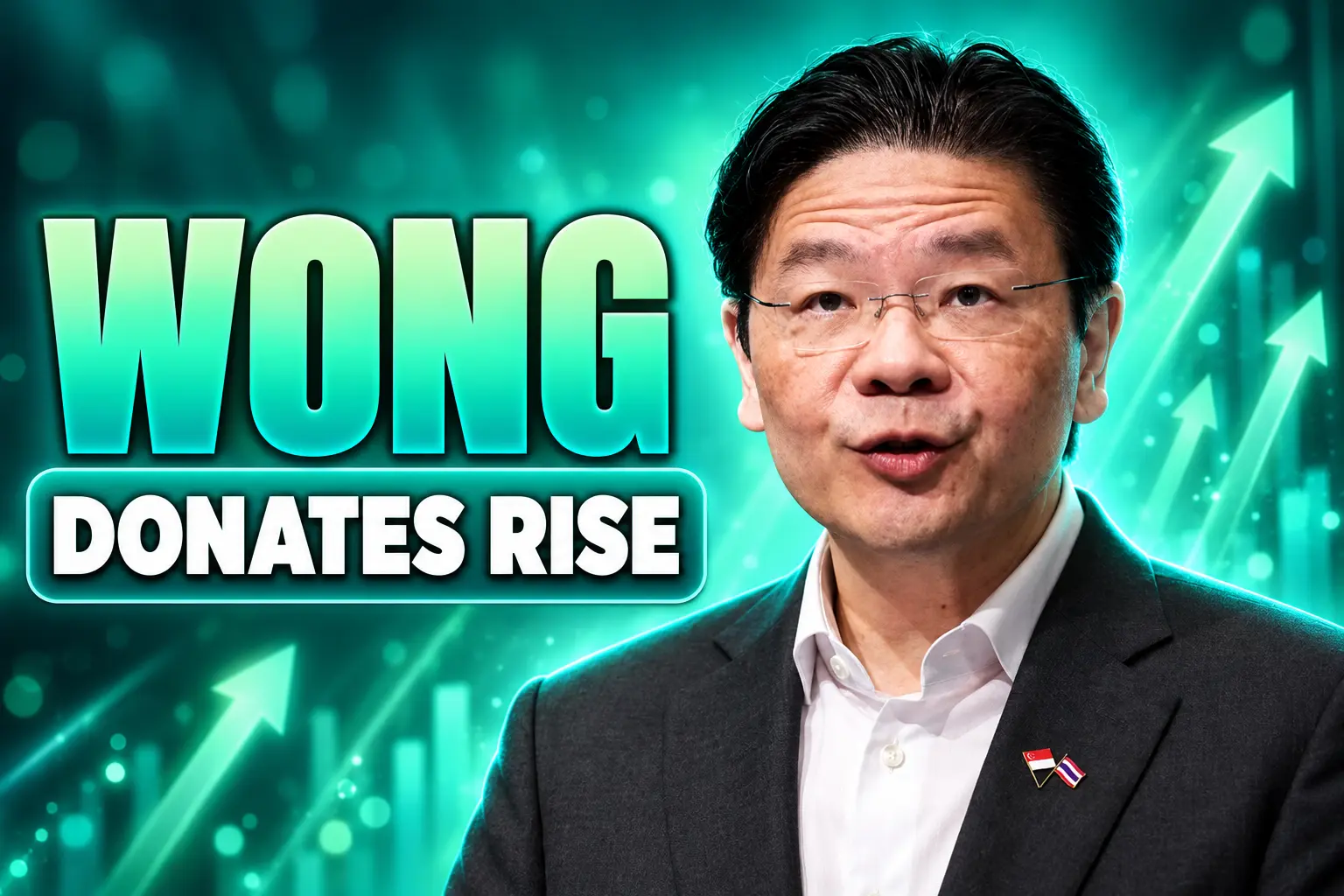
Wong said he will give the full increase, some S$1.4 million a year, to “suitable good causes” for the next five years. He did not ask other officeholders to copy him. If he serves the five years, that pledge is S$7.0 million he will not keep. The raise still rewrites the public baseline for whoever holds the job after him.
He told parliament he holds “ultimate responsibility” for the salary system and wanted to be clear about how he would handle his own increase. The cleaner reading is also the colder one. A five-year giveaway is a long apology for a rise nobody forced him to take, and it is the price of putting the formula back in force without taking the whole political hit in one month.
Political salaries are a difficult and emotive issue. The sums involved are more than what most citizens earn. So I understand why Singaporeans scrutinise them closely, and why many feel strongly about the matter. It is certainly not an issue Ministers themselves find easy to discuss. But we run an open system and believe in being transparent about ministerial salaries. We cannot avoid this issue simply because it is politically difficult. And this is not just a matter of pay. It is ultimately about whether Singapore will continue to have the quality of political leadership we need to take our country forward and to serve Singaporeans well in the years ahead.
Lawrence Wong, Prime Minister, ministerial statement in parliament, 8 September 2026
Eugene Tan, a political analyst and associate law professor at Singapore Management University, said the announcement could come across as “tone-deaf or even self-serving” given economic uncertainty and technological disruption at work. He added that most Singaporeans accept that ministerial pay cannot match the top of the private sector, and still struggle emotionally with leaders earning this much. The donation tries to answer that feeling without shrinking the peg.
Why the Formula Tracks the Richest 1,000 Earners
Singapore still prices a minister against the middle of its best-paid 1,000 citizens, then knocks 40 percent off to mark public service. The 2026 committee, chaired by Gan Seow Kee, chairman of Singapore LNG Corporation and an alternate member of the Council of Presidential Advisers, said that pool is diverse enough to show the calibre the country wants in office, and that a median is stabler than an average pulled up by outliers.
Gan said the committee reviewed the method and the data and found the formula “relevant and fair, with an explicit discount to reflect the ethos of political service.” He also said an unchanged package for 15 years risks deterring the people the system says it needs. Wong used a public-service story of his own: as chief executive of the Energy Market Authority he hired an LNG terminal lead at a package “far more” than his own pay, over HR objections, and the project came in on time and on budget.
Ja Ian Chong, a political scientist at the National University of Singapore, said it is unclear why political pay should be tied to so few high earners. “That sort of linkage could link the perspective of politicians more closely to the richest segment of Singapore society,” he said. The committee’s own defence is that those 1,000 names are the market for the talent it wants. Chong’s point is that the market then becomes the worldview.
Wong said some senior permanent secretaries already earn more than ministers, not because the political formula changed, but because successive governments held it still while the rest of the public service moved. Private-sector pay moved too. Judicial pay was updated. The political line did not. That is the talent case in one comparison: the people who work under ministers can out-earn them, and the people the government says it wants to recruit can out-earn them by more.
Fifteen Years of Frozen Pay Catch Up in One Step
The present system was built after the 2011 general election, when the People’s Action Party’s share of the popular vote fell to its lowest level of any general election and living costs were the live complaint. An independent committee then set the MR4 reference at S$1.1 million. Wong said a 2017 committee later recommended a rise and the government refused it, and a 2023 review was deferred. The freeze, in his telling, was restraint that calcified.
Senior Minister Lee Hsien Loong, Wong said, had hoped to settle the file before leaving the premiership and “would have preferred not to leave a difficult issue like this to his successor.” The circumstances did not allow it. “So the responsibility now falls to me,” Wong said. “It would have been easier politically for me to leave things as they are. But that would not be the right thing to do.” He added that a rule affirmed in principle and ignored in practice loses its meaning. “Restraint cannot become neglect.”
THE PAY FREEZE THAT LASTED 15 YEARS
- 2011: The last change sets the MR4 reference at S$1.1 million after an election that cut the PAP’s vote share.
- 2017: A review committee recommends a rise; the government makes no change.
- 2023: A scheduled review is deferred.
- December 2025: A committee chaired by Gan Seow Kee is appointed.
- 8 September 2026: The government accepts a new S$1.8 million MR4 peg and caps sitting officeholders at 9 percent.
- 10 September 2026: Parliament debates the response.
- 15 October 2026: New rates take effect.
The government said the S$1.1 million to S$1.8 million move works out to 3.6 percent a year since 2011, slower than income growth for Singaporean earners at the median and the 20th percentile. That annualised figure is the official reply to anyone who only sees a 64 percent jump on the prime minister’s line. Both descriptions are arithmetically true. They describe different choices: a delayed catch-up versus a one-day headline.
High Pay Did Not Stop the Iswaran Case
Singapore has long sold high political pay as a graft vaccine. The Corrupt Practices Investigation Bureau, citing Transparency International’s 2025 index, said the city-state remained the third least corrupt country of 182, with a score of 84, and first in Asia-Pacific. The United States placed 29th on the same index. The CPIB said public-sector cases stay low and that “zero-tolerance towards corruption” remains the country’s reputation in one phrase.
Even on that record, pay is not a lock. On 3 October 2024, Justice Vincent Hoong sentenced former transport minister S. Iswaran to 12 months in prison, the first cabinet member jailed in nearly half a century. The gifts worth S$403,297.92 came from two businessmen Iswaran dealt with in office: S$384,340.98 from Ong Beng Seng, majority owner of the Singapore Grand Prix promoter, and S$18,956.94 from Lum Kok Seng. Iswaran pleaded guilty to four counts of obtaining valuable things as a public servant and one of obstructing justice, and admitted 30 further charges taken into consideration.
The High Court judgment opens on trust, not on salary. “Trust and confidence in public institutions are the bedrock of effective governance, which can all too easily be undermined by the appearance that an individual public servant has fallen below the standards of integrity and accountability,” Hoong wrote. The gifts included ten Green Room Formula 1 tickets worth S$42,265, a Doha trip on a private jet and a hotel night, and a Brompton bicycle. Iswaran did not declare them. He later paid S$5,700 for a return flight, the act that became the obstruction charge.
Chong said rare graft cases suggest high pay may reduce the incentive to steal, and that it is “not completely foolproof.” He also said very high compensation “may blunt the public service element of serving in political office, which should be key to elected officials.” The Iswaran file does not prove that S$1.1 million was too low. It does prove a minister already paid in the global top tier still took tickets, wine and a bike from people with business before him.
What an Entry Minister Earns Against the Median Wage
A full-time employed resident at the middle of Singapore’s pay scale earned a median gross monthly income of S$5,775 in 2025, including employer Central Provident Fund, according to the Ministry of Manpower. That is S$69,300 a year. The 2024 median was S$5,500. In 2011, when ministerial pay was last reset, the same series stood at S$3,249 a month.
Put beside the new political line, the multiples are blunt. An MR4 package of about S$1.2 million is roughly 17 times last year’s median full-time wage. The prime minister’s new formula, S$3.6 million, is about 52 times that median. Wong’s current package already sits more than four times the US president’s $400,000 government salary and well above Hong Kong Chief Executive John Lee’s $719,000. The new formula is seven times the White House figure.
THE GAP IN ONE SNAPSHOT
- Median wage: Full-time resident employees sat at S$5,775 a month in 2025, or S$69,300 a year.
- MR4 after 9 percent: About S$1.2 million a year, roughly 17 times that median.
- Prime minister formula: S$3.6 million a year, about 52 times the median, with S$1.4 million pledged away for five years.
- Clean ranking: Singapore scored 84 and ranked third of 182 on the 2025 Corruption Perceptions Index.
Those ratios are why the donation exists. They are also why the 9 percent cap exists. The government can argue, correctly, that the 15-year freeze lagged median wage growth. It cannot argue that an entry minister on S$1.2 million is close to the household in the middle. Tan’s “tone-deaf” line is a description of that distance, not a claim that Singapore cannot afford the cheque.
MPs Get a Bigger Allowance From October
Elected MPs move from S$13,750 to S$18,500 a month from 15 October, a rise of S$4,750. Nominated and non-constituency MPs rise with them. That change is not capped at 9 percent. It is the full new allowance, paid on the same day the ministerial one-off begins. For backbenchers the politics are inverted: they take the whole step the cabinet is being denied.
WHAT ELSE MOVES ON 15 OCTOBER
- Merged minister grades: MR2 and MR3 become one grade, pegged at 1.3 times MR4, the midpoint of today’s 1.2 and 1.4 multipliers.
- Wider bands: A minister’s salary can sit between 75 and 125 percent of the grade reference, so a late joiner can come in lower and a seasoned hire can lose less against a private offer.
- Junior officeholders: Mayors, senior parliamentary secretaries and parliamentary secretaries merge into one grade at 0.45 times MR4, with a 70 to 130 percent range.
- National Bonus: Targets that tie political pay to unemployment, income growth and other social measures are tightened, and the government said it will look at a quality-of-life measure once one exists.
Wong said the 2012 pay debate saw “considerable convergence” with the Workers’ Party on transparency, no hidden perks, and a discount for public service, even though the party wanted a different formula. Parliament is due to debate this package on 10 September, with Wong and Chan answering. The opposition has not yet put a 2026 number of its own on the record. The PAP has held power without a break since 1959. That history is why the government can restore a freeze this large, and why it still needs the prime minister to refuse the extra cash.
The new rates start on 15 October. Wong’s extra S$1.4 million a year is supposed to leave his account for “suitable good causes” for five years. The S$1.8 million peg remains on the books for whoever comes next, donation or no donation.

Align Research Prices Legal AI at $100 a Job

Trump Offered Putin a Trade Prize to End Ukraine’s War

Singapore’s Prime Minister Gets the Raise He Will Not Keep

Copper’s Longest Rally Since 1994 Sits in U.S. Warehouses

Sharon AI Walks an $8.8 Billion Book Into Goldman
Sharon AI Walks an $8.8 Billion Book Into Goldman

CDC Holds Pennsylvania Measles Deaths Off the U.S. Tally

Tropical Storm Edouard Left Houston Open and Beaumont Dark
Copper’s Longest Rally Since 1994 Sits in U.S. Warehouses

Congo Rolls Out Ervebo Against a Different Ebola Virus
-
 NEWS3 weeks ago
Sharon AI Walks an $8.8 Billion Book Into Goldman
-
 NEWS3 weeks ago
CDC Holds Pennsylvania Measles Deaths Off the U.S. Tally
-
 NEWS4 weeks ago
Tropical Storm Edouard Left Houston Open and Beaumont Dark
-
 BUSINESS2 weeks ago
Copper’s Longest Rally Since 1994 Sits in U.S. Warehouses
-
 LIFESTYLE4 weeks ago
Congo Rolls Out Ervebo Against a Different Ebola Virus
-

 BUSINESS4 weeks ago
Cash Still Buys Nearly One in Three U.S. Homes
-

 NEWS3 weeks ago
The Agent Harness Turns Safety Into Switching Cost
-

 NEWS3 weeks ago
Nationwide Bets on Data Work Before It Trusts Agents