
NEWS
Western Digital’s HDD Boom Prints 54.1% Margins After Flash
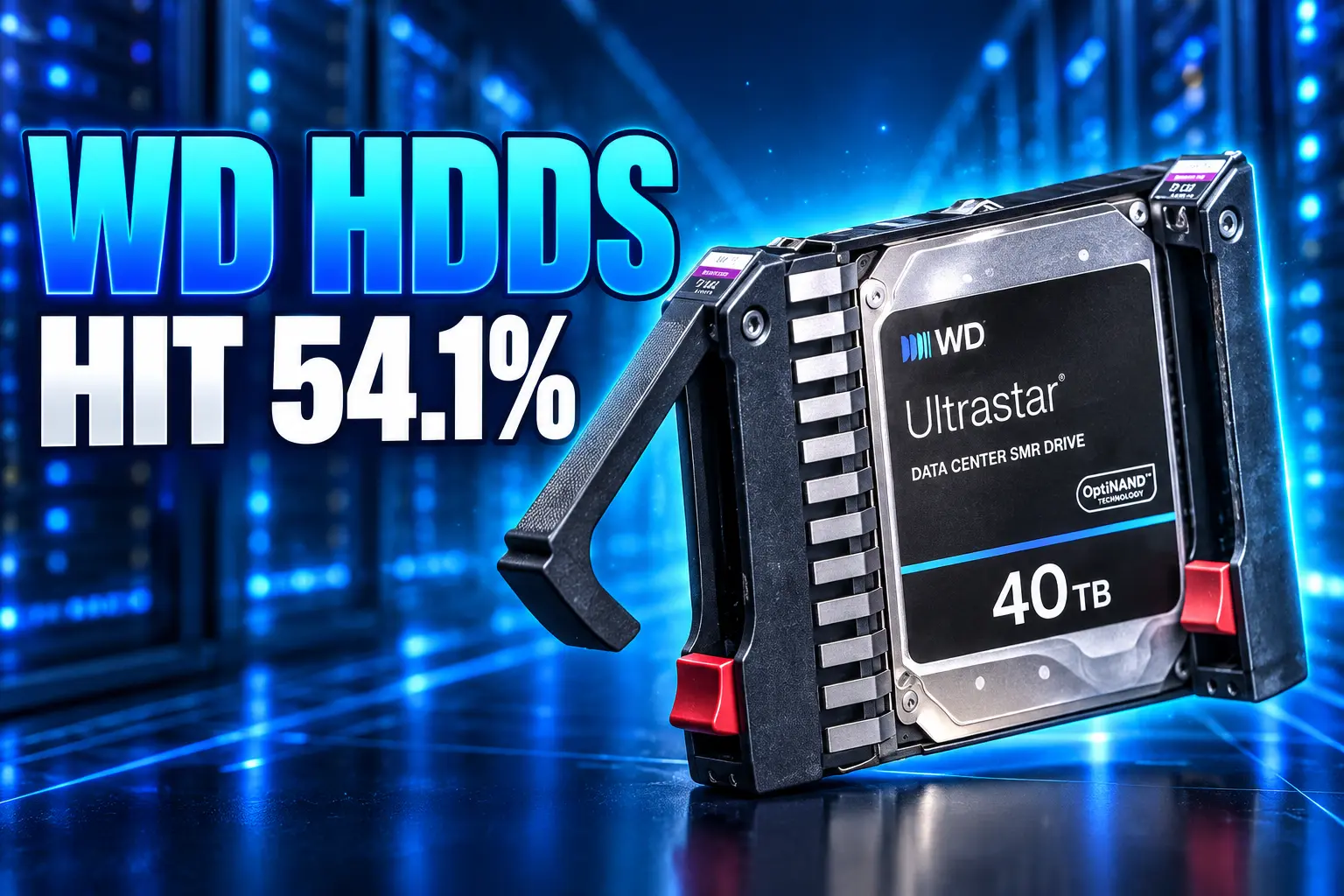
Western Digital’s first full year as a disk-only company posted 54.1% margins and 89% cloud sales, while its 44TB HAMR drive still sits in 2027.

Western Digital posted $3.75 billion in quarterly sales, up 44%, and a 54.1% gross margin on hard disk drives. Cloud buyers took 89% of that quarter, the first full fiscal year after the company sent its flash business out the door.
The disk half is printing margins that used to belong to chips. It is also a year behind Seagate Technology on the density node those same cloud buyers are already installing.
A $3.75 Billion Quarter at 54.1% Gross Margin
The company reported fiscal fourth quarter and fiscal year 2026 results for the period ended July 3, 2026. Sales were $3.75 billion, up 12% from the prior quarter. GAAP gross margin reached 54.1%, and the non-GAAP figure was 54.4%, up 1,310 basis points from 41.0% a year earlier.
Chief executive Irving Tan called it the first full year of WD as a focused hard-disk company. Sales for the year were $12.9 billion, up 36% from $9.52 billion. Non-GAAP earnings per share for the year were $10.22. Free cash flow was $3.5 billion, a 27% margin, and the company returned $3.1 billion to shareholders while moving to a net cash position.
GAAP diluted earnings per share for the quarter were $8.21, against non-GAAP earnings of $3.56. The GAAP line still carries the leftover Sandisk stake. Cash from operations was $1.39 billion and free cash flow was $1.28 billion. Operating expenses were $382 million, about 10% of sales, and non-GAAP operating margin hit 44.2%.
Q4 AND FULL-YEAR SNAPSHOT
| Metric | Q4 FY2026 | Fiscal 2026 |
|---|---|---|
| Revenue | $3.75 billion (+44% YoY) | $12.9 billion (+36% YoY) |
| GAAP gross margin | 54.1% | 48.9% |
| Non-GAAP gross margin | 54.4% | 49.1% |
| Non-GAAP EPS | $3.56 | $10.22 |
| Free cash flow | $1.28 billion | $3.5 billion |
| Exabytes shipped | 231 (+22% YoY) | Not broken out in the release |
Chief financial officer Kris Sennesael said revenue, gross margin, and earnings all landed at or above the high end of guidance. For the fiscal first quarter of 2027 he guided to $4.1 billion of sales, plus or minus $100 million, non-GAAP gross margin of 55% to 56% (55.5% at the midpoint), and non-GAAP earnings of $4.00 a share, plus or minus $0.15. That sales range is 42% to 49% above the year-earlier quarter.
The board declared a $0.15 cash dividend, payable September 17, 2026, to holders of record on September 8, 2026.
Sandisk Walked Out With the Flash Business in February 2025
On February 21, 2025, Western Digital finished the split of its flash unit into Sandisk Corporation. Results after that date no longer include flash. For earlier periods, Sandisk sits in discontinued operations, which is why the year-on-year disk figures look clean.
The split was the bet. Keep the spinning drives, hand NAND to a separate ticker, and let each side talk to its own buyers. Tan told analysts the first full year of that setup produced the 36% sales lift and the margin jump. It also left WD with one product family and one dominant end market.
The company did not stop at the distribution. In February 2026 Sandisk priced a secondary offering of Sandisk stock still held by its former parent: 5,821,135 shares at $545.00, about $3.17 billion, swapped against WD debt held by bank affiliates. Sandisk took none of the cash. After that sale WD still held 1,691,884 shares. During the July quarter it finished the job, exchanging the remaining 1.7 million Sandisk shares for 4.8 million of its own.
THE PATH TO A DISK-ONLY COMPANY
- February 21, 2025: The flash separation takes effect at 11:59 p.m. Pacific time.
- February 24, 2025: Sandisk begins regular-way Nasdaq trading under SNDK.
- February 17, 2026: Sandisk prices the 5,821,135-share secondary at $545.00.
- Quarter ended July 3, 2026: WD exchanges the last 1.7 million Sandisk shares for 4.8 million WD shares.
- August 5, 2026: WD reports the first fully disk year, with Q4 sales of $3.75 billion.
The tape still bunches WD with NAND names when memory stocks sell off. A July swing that hit Sandisk, Micron, and the two disk makers in the same hour showed how little the split changed the way traders group the tickers, even after flash left the books.
Three Cloud Buyers Now Deliver 44% of Annual Sales
Cloud was $3.3 billion in the fourth quarter, 89% of sales, up 43% from a year earlier. Client was $225 million, 6% of sales, up 61%. Consumer was $187 million, 5%, up 38%. Sennesael said both smaller lines got help from higher prices, but they are rounding error next to hyperscale.
For the full year, the company’s annual report shows cloud revenue of $11.49 billion, again 89% of the $12.9 billion total, up 38%. Client was $726 million and consumer $703 million. Cloud exabytes sold rose 27% and average selling price per exabyte rose 8%. Across the whole company, exabytes sold rose 25% and price per exabyte rose 8%.
Q4 SALES BY END MARKET
| End market | Revenue | Share of Q4 | Year-on-year |
|---|---|---|---|
| Cloud | $3.3 billion | 89% | +43% |
| Client | $225 million | 6% | +61% |
| Consumer | $187 million | 5% | +38% |
Concentration is tighter than the 89% cloud label. Three customers accounted for 16%, 15%, and 13% of fiscal 2026 net revenue, or 44% together. The top 10 customers were 73% of sales, up from 68% in 2025 and 55% in 2024. Two customers were 25% and 17% of receivables at year end. In 2024, no single customer had reached 10%.
That mix is why a high-teens rise in price per terabyte dropped straight through. Sennesael said the blended year-on-year price increase per terabyte moved from high single digits in the prior quarter to high teens in Q4. Nearline demand was strong enough that WD could raise price while shipping 231 exabytes, up 22%.
The other side of that mix is leverage in reverse. Client and consumer no longer buffer a pause in cloud capex. In September, management said customers are requesting long-term agreements that run through 2030 and 2031. Hyperscalers want the slots. They also want the price locked, which is the fight underneath the 54.1% margin.
Seagate Already Ships the 44TB HAMR Drive
Tan said WD is on track to ship its 44-terabyte heat-assisted magnetic recording drive in the first half of calendar 2027, and that qualification feedback on capacity, performance, and reliability has been positive. That is the node Seagate is already selling.
On March 3, 2026, Seagate said its Mozaic 4+ platform, with 44TB HAMR drives in hyperscale production, was qualified and shipping to two leading cloud providers. Seagate called it the only HAMR platform deployed at scale. WD’s answer in the June quarter was a 40-terabyte drive that does not use HAMR at all.
WHERE THE TWO ROADMAPS STAND
| Item | Western Digital | Seagate |
|---|---|---|
| Highest capacity shipping now | 40TB ePMR with UltraSMR | 44TB HAMR (Mozaic 4+) |
| 44TB HAMR status | First half of calendar 2027, in qualification | In production at two hyperscalers since March 2026 |
| Nearline HAMR mix disclosed | Not disclosed | Described as the only HAMR platform at scale |
| Next WD capacity crutch | UltraSMR, about 60% of nearline exabytes by the end of FY2027 | Further Mozaic density steps |
WHAT WE KNOW
- The 40TB ship: WD began 40-terabyte ePMR shipments in the June quarter and is entering volume production with two customers.
- The 2027 date: Management is holding the first half of calendar 2027 for 44TB HAMR.
- The rival node: Seagate has had 44TB HAMR in two hyperscale clouds since March 2026.
WHAT IS UNCONFIRMED
- WD’s HAMR mix: The company has not said what share of its nearline exabytes already ships on HAMR.
- Who the two Seagate clouds are: The hyperscalers were not named.
- Whether 40TB holds share: Volume on the new ePMR platform is just starting, so the 50% nearline-bit target for the third quarter of fiscal 2027 is still a forecast.
WD does not have to win the terabyte race on Seagate’s calendar to print these margins. It does have to stay close enough that the three buyers who are 44% of sales do not move the next density step to the other vendor. That is the cost of a disk-only company that lives on a handful of cloud accounts.
Why Hyperscalers Still Park 80% of Data on Disks
Tan’s case for why the archive layer still spins is blunt. Compute gets reused. Data does not. Training writes a first pile of weights and logs. Inference then writes more, every day, and agent-style systems write at every step of a workflow. Physical AI, robots, vehicles, factory sensors, adds another pile, some of it synthetic because the real-world set is too small.
Today, roughly 80% of data stored in a hyperscale data center resides on hard disk drives. That is likely to continue. That reflects what HDDs do exceptionally well, delivering the scale, economics, and power efficiency required for long retention, large-scale data storage.
Irving Tan, CEO, Western Digital Q4 FY2026 earnings call
That 80% figure is why a company that exited flash can still claim an AI story. The hot path, KV cache, checkpoints that need to move fast, sits on NAND. The long-keep path, training corpora, logs, retained context, still sits on disks because a rack of high-capacity drives is cheaper and sips less power per terabyte than a rack of QLC SSDs. Tan’s line is that this split holds as inference and agents pile up more bytes, not fewer.
The annual report puts the same idea in plainer words: HDDs are the cost-effective, high-capacity layer for cloud data centers, and AI plus hybrid data is lifting that layer. Fiscal 2026 ran 53 weeks against 52 in 2025, a small calendar tailwind on top of the real volume and price lift.
UltraSMR and High Bandwidth Bridge the HAMR Gap
The 40-terabyte drive now shipping uses energy-assisted perpendicular magnetic recording, plus UltraSMR, WD’s shingled layout. It is not a HAMR product. A current on the write-head pole packs more bits per inch without a laser. Shingled tracks then overlay like roof tiles, which buys capacity if the buyer can live with heavier rewrite costs. Hyperscalers can, on the cold and warm tiers. Desktops mostly cannot.
Sennesael said the 40-terabyte platform is on track for 50% of nearline bits by the third quarter of fiscal 2027. Tan said UltraSMR is ramping with a third major customer and should be about 60% of nearline exabyte shipments as WD leaves fiscal 2027. That is how WD stays near 40TB-class capacities while HAMR is still in qualification.
THE BRIDGE FROM HERE TO 2027
- 40TB ePMR: Shipping since the June quarter, volume with two customers, aimed at half of nearline bits by Q3 FY2027.
- UltraSMR: Third major customer ramping; about 60% of nearline exabytes by the end of fiscal 2027.
- 44TB HAMR: Still dated to the first half of calendar 2027, with two cloud customers in qualification from earlier updates.
- High bandwidth drives: Sampling with five customers, targeting up to 8x the throughput of current nearline disks without a matching rise in power.
The bandwidth work is the quieter half of the roadmap. Capacity has climbed for years while sequential speed sat near 250 to 300 MB/s. A denser drive that still streams at that rate takes longer to fill, empty, and rebuild. Tan framed the 8x target as the performance AI ingestion actually wants. It is sampling, not a volume product, and it is the item on the public roadmap that tries to keep disks in the warm path instead of ceding that tier to flash.
Price is doing as much work as physics. A high-teens lift per terabyte, a mix shift into higher-capacity nearline, and opex held near 10% of sales are what turned 22% more exabytes into 44% more revenue and a 54.1% GAAP margin. The guide at $4.1 billion and 55% to 56% gross margin assumes that mix and that price hold for another quarter.
The flash business is gone, the last Sandisk shares are gone, and the disk company that remains is the one posting chip-like margins on archive hardware. The same three cloud accounts that made that possible are already taking 44TB HAMR from the other supplier, and they are the accounts asking for supply through 2031.
Frequently Asked Questions
When Did Western Digital Finish the Sandisk Spin-Off?
The separation became effective at 11:59 p.m. Pacific time on February 21, 2025. WD stockholders received one Sandisk share for every three WD shares, and Sandisk began regular-way Nasdaq trading under SNDK on February 24, 2025, with holders other than WD owning 80.1% of the flash company at the open.
What Does ePMR Change on a Hard Drive?
Energy-assisted perpendicular magnetic recording runs an electrical current through the main pole of the write head during the write, which lets the head pack more bits along each track. WD first shipped it on 18TB CMR and 20TB SMR Ultrastar drives; the 40TB nearline drive now ramping is a later ePMR generation paired with UltraSMR, not a laser-based HAMR design.
What Happened to WD’s Last Sandisk Shares?
After the February 2026 secondary of 5,821,135 shares, WD still held 1,691,884 Sandisk shares. In the quarter ended July 3, 2026 it exchanged those remaining 1.7 million shares for 4.8 million WD shares, which is why GAAP earnings of $8.21 in Q4 still look very different from the $3.56 non-GAAP figure.
Why Does Fiscal 2026 Have an Extra Week?
WD’s fiscal 2026, ended July 3, 2026, ran 53 weeks, with a 14-week first quarter and 13-week periods after that. Fiscal 2025 and 2024 each ran 52 weeks. The extra week is a small aid to the 36% annual sales comparison and is separate from the 25% rise in exabytes and the 8% rise in price per exabyte reported in the annual filing.
Disclaimer: This article is news reporting and analysis of Western Digital’s public results, filings, and product roadmap, and it is for information only. It is not investment advice, a rating, or a recommendation to buy, sell, or hold WDC, SNDK, STX, or any other security, and it is not a substitute for a prospectus, 10-K, or broker research. Readers who are considering a position in storage or semiconductor stocks should consult a licensed financial adviser or broker who can match any trade to their own objectives, time horizon, and risk limits. Revenue, margin, shipment, guidance, and product-timing figures here reflect company statements and filings as published around the August 5, 2026 earnings release and the fiscal 2026 annual report, and those figures can change in later quarters.

Jay-Z Accuser Recants, but Her Lawyer Remains Sued

Treasury Squeeze Forces Iran’s Neighbors to Cut Banks and Flights

iPhone 18 Pro Preorder Deals Wipe $1,199 Over 36 Months

U.S. Steel and Aluminum Duties Hit the Factories That Use Them

A Yemen Cell Used Claude Code, Then Kept the Toolkit

Sharon AI Walks an $8.8 Billion Book Into Goldman

CDC Holds Pennsylvania Measles Deaths Off the U.S. Tally

Copper’s Longest Rally Since 1994 Sits in U.S. Warehouses

Tropical Storm Edouard Left Houston Open and Beaumont Dark

The Agent Harness Turns Safety Into Switching Cost
-
 NEWS3 weeks ago
Sharon AI Walks an $8.8 Billion Book Into Goldman
-
 NEWS4 weeks ago
CDC Holds Pennsylvania Measles Deaths Off the U.S. Tally
-
 BUSINESS3 weeks ago
Copper’s Longest Rally Since 1994 Sits in U.S. Warehouses
-
 NEWS1 month ago
Tropical Storm Edouard Left Houston Open and Beaumont Dark
-
 NEWS3 weeks ago
The Agent Harness Turns Safety Into Switching Cost
-

 BUSINESS4 weeks ago
Cash Still Buys Nearly One in Three U.S. Homes
-

 LIFESTYLE4 weeks ago
Congo Rolls Out Ervebo Against a Different Ebola Virus
-

 NEWS3 weeks ago
Nationwide Bets on Data Work Before It Trusts Agents